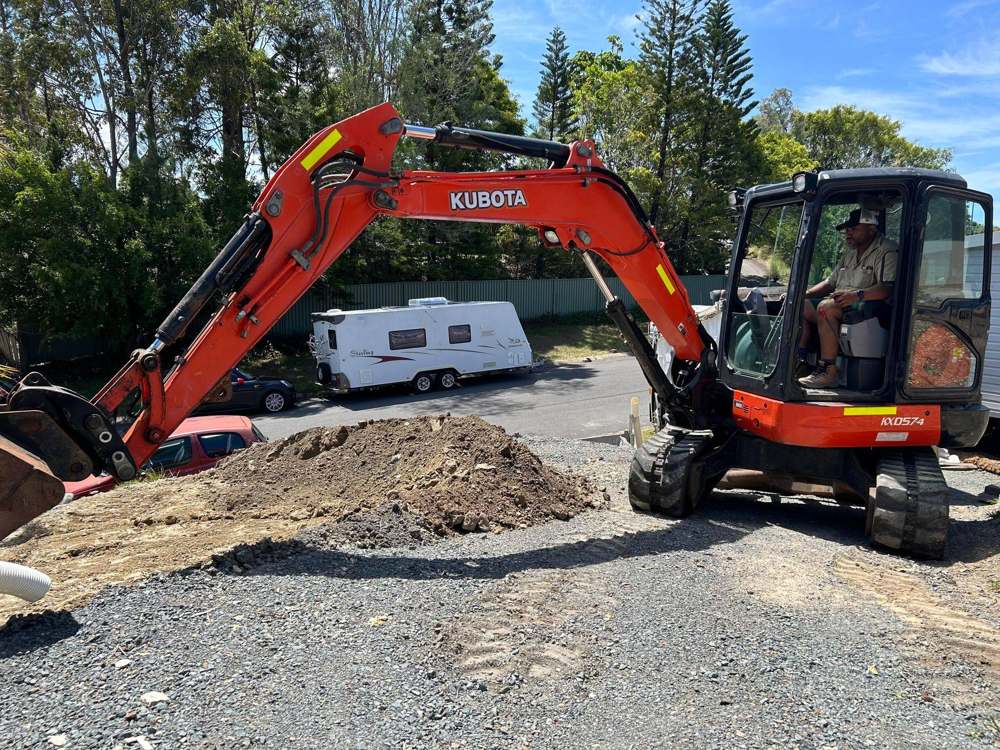
Short answer: nobody can give you an honest excavation price per cubic metre before they have seen the block. The number is really the machine time, truck movements and tip fees it takes to shift your dirt, and those swing a long way between a flat sandy lot in Forest Lake and a rocky, sloping one in Ipswich. Below is what actually moves the price in Brisbane, how to compare an hourly rate with a lump sum, and what to send us so the excavation quote you get back means something.
Why won’t anyone give me a straight price per m3?
Because a cubic metre is not one thing. One is a cubic metre of dry loam that the 8 tonne machine scoops in a single pass and the tipper carts to a clean-fill site twenty minutes away. Another is a cubic metre of wet reactive clay on a tight battle-axe block where the excavator has to be a 6 tonne, the spoil goes out in a small tipper because a truck and dog cannot get in, and the tip charges by the tonne for the water you are hauling with it. Same “m3”, nowhere near the same cost.
There is also the bank versus loose problem. Volume on the plans is bank cubic metres, meaning dirt measured in the ground. Once it is dug it fluffs up, often by a quarter or more depending on the material, so the loose volume you pay to cart and tip is larger than the cut shown on the drawings. If a quote looks cheap per m3, check which m3 it is talking about.
So when a contractor says “it depends”, that is not dodging. Anyone quoting a flat per m3 rate over the phone is either guessing or planning to find the extras once the machine is on site.
What actually moves the price on a Brisbane dig?
Access. Can an 8 tonne excavator and a truck get to the hole, or does everything go through a 2.4 metre side gate? Tight access means a smaller machine, more passes, more hours, and often a bobcat shuttling spoil to the street. On a lot of older southside blocks the access decides the price before the ground does.
What is under the grass. A lot of Brisbane’s south and south-west sits on reactive clay that digs fine dry and turns to glue after rain. Around Ipswich and the western fringe you can hit shale and sandstone that needs a ripper or a rock breaker, and a breaker turns a one day dig into three. Nobody knows for sure until the bucket goes in, which is why a quote should say what happens if rock turns up.
Haulage and tip fees. Carting is usually the biggest line after the machine. Distance to the tip, whether the spoil is clean fill or contaminated, how many loads, and whether it is a truck and dog or a single tipper all land on your bill. Clean, dry, uncontaminated spoil is cheaper to get rid of. Anything with concrete, asbestos risk or acid sulfate soil is another conversation.
Weather. Storm season from November to March in South East Queensland can stop a dig cold. Wet clay cannot be compacted, trucks bog, and sites turn into a sediment control problem. Dry season digs are faster and cheaper for the same volume.
Services and depth. Every job starts with a Before You Dig Australia enquiry. Water, sewer, Energex and NBN running through the cut mean hand digging or potholing around them. Deep cuts for basements and pools need batters or shoring, and that is engineering time as well as machine time.
Trees. Roots and stumps in the cut slow a machine down, and council protected vegetation can stop the job altogether. If the block still has trees on it we get our arborist side to handle clearing the block first so the excavator is not fighting root plates all day.
Detail work. Bulk cut to a rough level is quick. Final trim to within tolerance for a slab, battered edges, and trenching for footings and drainage is slower, more skilled machine work. We explain the difference in our guide to bulk and detailed excavation.
Hourly wet hire or a lump sum, which is better?
Both are fair, for different jobs. Wet hire means the machine comes with an operator and you pay by the hour. Our excavator wet hire rate is $165 per hour plus a minimum charge and any attachments such as augers, rippers or breakers. Hourly suits jobs where nobody can see the end from the start: a dig with unknown ground, a site with a lot of small tasks, or a builder who wants a machine on call for a week.
A lump sum suits jobs with clear drawings and a measurable volume: a house pad, a pool hole, a site cut shown on an engineer’s plan. You get a fixed price, and the contractor carries the risk of being slow. The catch is in the exclusions. Read what happens with rock, contaminated spoil, wet weather delays and extra tip loads, because that is where a cheap lump sum grows legs.
Our rule of thumb: if you can measure it, price it. If you cannot, pay by the hour and keep the trucks honest with load dockets. For a broader breakdown of the whole site works budget, our site preparation cost guide covers the lines that sit around the excavation.
Do I need council approval to excavate?
Often not for small work, sometimes yes for the rest. Brisbane City Council’s filling and excavation page says you do not need planning approval to raise or lower the ground level by up to one vertical metre, unless the site is in a neighbourhood plan area or affected by an overlay, and that filling or excavating more than one vertical metre to build a structure needs building approval through a licensed certifier. Flood, waterway and character overlays change the answer, so check your lot on City Plan online before you book a machine, or send us the address and we will look.
Logan and Ipswich have their own planning schemes with similar ideas and different numbers. If the dig is part of a pool, a retaining wall over a metre, or a subdivision, assume there is paperwork and build the time into the program.
How do I get an excavation quote that holds up?
Send the things that answer the questions above and you will get a tighter number. The site plan or engineer’s drawings with levels. Photos of the access from the street, including gates, power lines and the slope. The address, so we can check overlays and services. What the hole is for, because a pool dig and a shed pad want different finishes. And whether you have anywhere on site to stockpile spoil, since keeping some fill on the block can save a lot of truck movements.
Then ask every contractor the same three things: which m3 are you quoting, what is excluded, and what happens if we hit rock. The answers tell you more than the headline rate.
Where we dig
Dynamic Earth Solutions runs 6 and 8 tonne excavators and a tipper out of our yard at Ellen Grove, so most of our excavation work is across Brisbane’s south and south-west, including Forest Lake, Acacia Ridge and Richlands, plus Logan and Ipswich. We take on commercial and civil work further out by quote. We are a family-owned, Indigenous-owned contractor registered with Supply Nation, which matters if your project has procurement targets to meet.
Want a number for your block? Send the plans and a couple of photos through the quote form or call 0424 168 352 and we will tell you what the dig is likely to involve before anyone turns a key.
Frequently asked questions
How much does excavation cost per m3 in Brisbane?
There is no honest flat rate. The price per cubic metre depends on access, the ground (clay, shale or rock), how far the spoil travels and what the tip charges, the weather and how much detail work is needed. Send the plans and access photos and you will get a real number for your block rather than a guess.
Is it cheaper to pay by the hour or get a lump sum?
Hourly wet hire (our excavator rate is $165 per hour plus a minimum charge and attachments) suits jobs with unknown ground or a mix of small tasks. A lump sum suits a measurable cut on an engineer's plan. Check the exclusions on a lump sum for rock, contaminated spoil, wet weather and extra tip loads.
Do I need council approval to excavate my block?
In Brisbane, raising or lowering the ground by up to one vertical metre usually does not need planning approval unless your lot is in a neighbourhood plan area or under an overlay. More than a metre for a building needs building approval through a certifier. Logan and Ipswich have their own rules, so check the address first.
What is the difference between bank and loose cubic metres?
Bank cubic metres are dirt measured in the ground, which is what the plans show. Loose cubic metres are the same dirt after digging, often a quarter more. Carting and tipping are charged on the loose volume, so ask which one a quote uses.
What areas does Dynamic Earth Solutions cover for excavation?
Brisbane's south and south-west, Logan and Ipswich for residential and commercial excavation. Commercial and civil work further out is taken on by quote.