Salisbury — Brisbane’s Workhorse Industrial Suburb
Salisbury sits within the Salisbury Industrial Estate, one of South Brisbane’s most concentrated light-industrial precincts. Bounded by Evans Road to the north, the rail corridor to the west, Orange Grove Road to the south, and Ipswich Road threading through the east, this suburb has functioned as a logistics and manufacturing hub for decades. The postcode 4107 covers approximately 2.4 square kilometres, much of it zoned Industry under the Brisbane City Plan. For developers, builders, and councils commissioning demolition in Salisbury, the site characteristics here differ markedly from residential-dominant suburbs further south.
The underlying geology is predominantly Quaternary alluvium — silty clays and sandy clays deposited by Stable Swamp Creek, which drains the catchment before feeding into Bulimba Creek. These soils are reactive, classified commonly between H and E under AS 2870, with plasticity indices that demand careful earthworks sequencing after demolition. Standing structures on these lots typically include tilt-up concrete warehouses from the 1980s, brick-and-steel manufacturing sheds, and older fibro-clad workshops that often carry asbestos-containing materials.
Adjacent suburbs — Rocklea to the west, Moorooka to the north, Nathan to the east, and Coopers Plains to the south — share similar industrial heritage, which means demolition contractors working in this corridor encounter consistent building typologies. Rocklea Markets and the Queensland Department of Primary Industries facilities sit within walking distance, creating traffic and access considerations for haulage during commercial teardowns.
Salisbury’s proximity to major arterials makes it attractive for redevelopment. The Ipswich Motorway interchange at Rocklea, the South East Busway corridor, and rail access via Rocklea and Salisbury stations mean logistics operators and last-mile distribution centres are actively acquiring sites. This commercial pressure is driving demolition services demand as ageing warehouses make way for modern, higher-clearance distribution sheds or mixed-industry developments.
For Dynamic Earth Solutions, an indigenous-owned civil and excavation contractor based at Ellen Grove in Brisbane’s south-west, Salisbury represents a natural growth market. Our Supply Nation registration positions us for government and tier-one contracts where indigenous procurement targets apply — a growing requirement across Queensland infrastructure projects.
When a Demolition Job Becomes a Civil Job
Demolition in isolation is rarely the end point. On commercial and industrial sites, the teardown phase is the opening chapter of a civil construction sequence. Recognising where demolition ends and civil works begin — and planning for that transition — separates efficient projects from those plagued by hold-ups.
Demolition as Civil Enabling Works
A Salisbury warehouse teardown typically produces a cleared footprint that requires immediate civil follow-on: bulk excavation to formation level, stormwater infrastructure installation, subgrade preparation, and ultimately slab or pavement construction. When the demolition contractor understands the civil scope, sequencing improves. For example, selective retention of hardstand areas can provide stable laydown space for civil plant, reducing the need for temporary stabilisation on reactive clays.
At Dynamic Earth Solutions, we approach demolition as the first phase of our complete civil services list rather than a standalone trade. This integrated model means our site supervisors plan demolition access routes with future civil traffic in mind, ensuring haul roads align with eventual drainage easements or service corridors.
Contract Structures That Reflect Reality
Developers engaging separate demolition and civil contractors often encounter interface disputes: who is responsible for removing below-ground obstructions discovered during excavation? Who bears the cost of additional spoil haulage when footings are deeper than drawings indicated? A combined demolition-and-civil contract eliminates these grey zones.
Our building site preparation scope explicitly addresses this interface. We price demolition with civil follow-on in mind, and our lump-sum or schedule-of-rates structures can accommodate discovered conditions without adversarial variation claims.
Timing Triggers
On a Salisbury industrial estate clearance, the demolition-to-civil handover typically hinges on three milestones:
- Hazmat clearance certificate: Issued by a licensed asbestos assessor confirming the site is free of friable and bonded asbestos, allowing civil workers to enter without Class A or B licences.
- Service disconnection confirmation: Written advice from Energex, Urban Utilities, Telstra, and APA Gas confirming all services are isolated, capped, or removed to the boundary.
- Survey set-out: Registered surveyor’s confirmation of boundary pegs and reduced levels to Australian Height Datum, enabling civil excavation to design formation.
Planning for these milestones during demolition procurement — rather than scrambling after knockdown — keeps projects on programme.
Hazardous Material Audits — Asbestos, Lead Paint and Contaminated Soils
Salisbury’s industrial history means hazardous materials are the rule, not the exception. Pre-demolition audits are mandatory under Queensland’s WorkSafe Queensland regulations, and failing to conduct them exposes principals, contractors, and workers to prosecution.
Asbestos-Containing Materials
Structures built before 1990 in Australia commonly contain asbestos-containing materials (ACMs). In Salisbury, fibro cladding on older workshops, vinyl floor tiles in office fitouts, millboard behind switchboards, and pipe lagging in plant rooms are frequent findings. A Division 5 hazardous materials survey — conducted by a competent person under the Work Health and Safety Regulation 2011 (Qld) — must be completed before demolition commences.
The survey identifies:
- Location and extent of ACMs
- Condition (friable or non-friable)
- Recommended removal methodology
- Estimated quantities for disposal costing
Friable asbestos (material that can be crumbled by hand pressure) requires removal by a Class A licensed asbestos removalist. Non-friable (bonded) asbestos over 10 square metres requires a Class B licence. Both classes must notify Workplace Health and Safety Queensland at least five days before removal commences for friable, and for bonded over 10 m².
Salisbury asbestos demolition projects often uncover legacy dumping beneath hardstands — a common practice before environmental awareness improved. Where unexpected asbestos-contaminated soil is discovered during civil excavation, works must cease pending further assessment. Our safety and compliance standards mandate stop-work protocols for any suspected ACM encountered outside the hazmat audit scope.
Lead Paint
Lead-based paints were phased out in Australia during the 1970s, but industrial buildings often retained them longer due to slower maintenance cycles. Structural steel, roller doors, and external cladding in Salisbury warehouses frequently test positive for lead. Blood lead level exposure limits under the Work Health and Safety Regulation 2011 require controls during demolition, including wet suppression, respiratory protection, and potentially air monitoring.
Contaminated Soils
Manufacturing and logistics operations leave chemical legacies. Common contaminants in Salisbury include:
- Hydrocarbons from fuel storage, vehicle maintenance, and lubrication systems
- Heavy metals from plating, coating, and battery storage
- Volatile organic compounds from solvent use
- Per- and polyfluoroalkyl substances (PFAS) from firefighting foam used in high-risk facilities
A Phase 1 Environmental Site Assessment (desktop study) should precede any demolition. Where Phase 1 identifies potential contamination pathways, Phase 2 intrusive investigation — soil sampling, groundwater monitoring — quantifies the extent. Remediation options range from excavation and off-site disposal to in-situ treatment or capping with an Environmental Management Plan.
For sites requiring Brisbane City Council planning and development approval, contaminated land provisions under the Environmental Protection Act 1994 apply. A Site Suitability Statement may be required before development approval is granted.
Service Disconnection — Energex, Urban Utilities, Telstra and Gas
Service disconnection is a critical-path activity that frequently delays demolition. In Salisbury, the density of industrial lots means services often run through adjacent properties, requiring easement coordination.
Electrical — Energex
Energex is the distribution network service provider for South East Queensland. Demolition sites require permanent disconnection, not just isolation. This involves:
- Lodging a disconnection request through Energex’s builder portal (minimum 10 business days lead time, often longer)
- Engaging a licensed electrical contractor to disconnect internal wiring
- Energex attending site to remove the service connection from the network
- Pole or pillar removal if the asset is on the lot being demolished
For high-voltage supplies — common in Salisbury manufacturing facilities — the process is more complex, involving site-specific disconnection plans and potentially transformer relocation.
Water and Sewer — Urban Utilities
Urban Utilities manages water supply and sewerage in Brisbane. Demolition requires:
- Water meter removal and supply capping at the main
- Sewer disconnection and sealing at the property boundary
- Trade waste disconnection for industrial premises with pre-treatment systems
Applications are lodged through the Urban Utilities development portal. Processing times vary from 5 to 15 business days depending on complexity. Failure to properly cap sewers can result in stormwater infiltration, hydraulic overloading, and council enforcement.
Stormwater connections are managed by Brisbane City Council stormwater drainage rather than Urban Utilities. Disconnection or modification requires council approval, particularly where sites drain to Stable Swamp Creek via the council’s stormwater network.
Telecommunications — Telstra and NBN
Telstra copper services and NBN fibre or HFC connections must be disconnected before demolition. Lead times of 20–30 business days are common, particularly for NBN infrastructure. Early lodgement is essential.
In Salisbury, legacy copper runs often traverse multiple properties via overhead or underground routes. Where demolition affects shared infrastructure, Telstra may require relocation at the developer’s cost.
Gas — APA Group
APA Group operates the gas distribution network in Brisbane. Industrial premises may have medium-pressure connections requiring specialist disconnection. Residential-scale connections are typically low-pressure and simpler to manage.
Gas disconnection requests should be lodged at least 15 business days before demolition. The gas main may remain live in the street; the disconnection point is at the meter and service pipe entry.
Dial Before You Dig
Prior to any demolition involving excavation, a Dial Before You Dig request is mandatory. This returns plans from all asset owners with infrastructure in the area, including Energex, Urban Utilities, Telstra, APA, and Optus. In Salisbury’s industrial precinct, expect complex plan sets with multiple overlapping services.
Our excavation services team integrates DBYD responses into every demolition and earthworks programme, ensuring service locations are verified on-site before any mechanical excavation commences.
Demolition Methodology for Mid-Sized Commercial Buildings
Salisbury commercial demolition typically involves structures between 500 and 5,000 square metres — the sweet spot for mid-sized teardowns. Methodology selection depends on structural form, site constraints, and programme requirements.
Mechanical Demolition
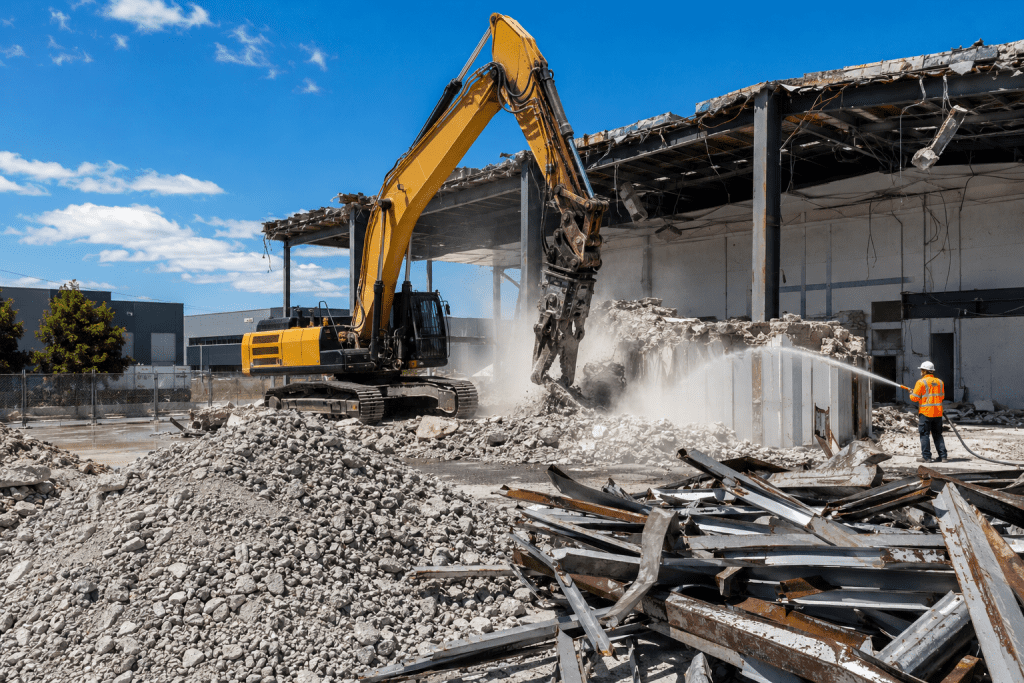
Most Salisbury warehouse teardowns proceed via mechanical demolition using excavators fitted with hydraulic attachments:
- Pulverisers: For crushing concrete slabs and footings in situ, reducing transport volumes
- Shears: For cutting structural steel, portal frames, and purlins
- Grapples: For sorting and loading mixed demolition waste
- Hammers: For breaking reinforced concrete elements that resist pulveriser action
Machine selection depends on building height and reach requirements. A 30-tonne excavator with a 15-metre reach handles most single-storey industrial buildings. Two-storey structures or those with mezzanines may require 45-tonne machines with extended dipper arms.
Our bulk and detailed excavations capability means the same machines can transition from demolition to foundation excavation without demobilisation, improving programme efficiency.
Deconstruction and Selective Demolition
Where materials have salvage value — structural steel, timber trusses, architectural features — selective deconstruction recovers these elements before mechanical demolition of the remaining structure. This approach is increasingly specified on projects targeting Green Star or ISCA ratings, where waste diversion targets apply.
Salisbury’s older industrial buildings occasionally contain heritage machinery or fittings that clients wish to retain. Selective methodology allows extraction before the envelope comes down.
Implosion and Controlled Collapse
Explosive demolition is rarely appropriate for Salisbury’s building stock. The scale (typically under five storeys), proximity to neighbouring operations, and cost relative to mechanical methods make implosion uneconomic. However, engineered collapse sequences — where structural elements are pre-weakened and pulled mechanically — can accelerate knockdown of steel-framed buildings.
Below-Ground Elements
Salisbury industrial sites frequently contain below-ground obstructions that complicate the demolition-to-civil transition:
- Pad and strip footings, often 400–600 mm deep
- Piled foundations in areas with poor bearing capacity near Stable Swamp Creek
- Service pits, sumps, and interceptor traps
- Fuel and chemical storage tanks — some decommissioned in situ without removal
Our demolition methodology addresses these elements as part of the knockdown scope, removing them to formation level or deeper as the civil design requires. This eliminates discovery disputes during subsequent footings and trenches excavation.
Site Clearance, Stump Grinding and Vegetation Removal
Salisbury industrial estate clearance often involves more than building demolition. Decades of neglect leave sites with established vegetation, including trees that may be protected under Brisbane City Council’s Natural Assets Local Law.
Tree Assessment and Approval
Before any vegetation removal, a tree assessment is required to determine which specimens require council approval for removal. Under Brisbane City Council tree regulations, significant trees — those with trunk circumference over 1.5 metres measured at one metre above ground — generally require a development permit for removal.
On industrial sites, mature specimens often include fig species (Ficus spp.), eucalypts, and introduced species like camphor laurel. While camphor laurels are declared weeds and exempt from protection, their removal still requires safe work practices due to size and location.
An Arboricultural Impact Assessment prepared by an AQF Level 5 consulting arborist is often required as part of development applications. This report assesses tree health, significance, and retention viability, providing recommendations that inform council decisions.
Our sister company, AQF-certified arborists in Brisbane, provides these assessments and coordinates professional tree removal Brisbane services where approvals are granted.
Vegetation Removal Methodology
Once approvals are secured, vegetation removal proceeds via:
- Climbing and sectional dismantling: For trees near structures, services, or boundaries where felling is unsafe
- Mechanical felling: Using excavators with grapple attachments for smaller trees in open areas
- Forestry mulching: For dense scrub and regrowth, forestry mulching converts vegetation to mulch in a single pass, which can be respread on-site or removed
For larger-scale site clearance, our land clearing Brisbane capability combines excavator-mounted tree shears with mulching heads to clear significant areas efficiently.
Stump Grinding
After tree removal, stumps must be ground below formation level to avoid obstruction during earthworks. Stump grinding typically extends 300–500 mm below natural surface, depending on the subsequent development. For building footprints, deeper grinding to 600 mm may be specified to clear footing zones.
We coordinate stump removal through All Sites Stump Grinding Brisbane, independent specialists who operate across Brisbane and provide stump grinding services into Ipswich. Their equipment handles stumps up to 2,000 mm diameter, with track-mounted machines capable of accessing confined industrial sites.
Stump grinding produces a soil-and-woodchip mix that should be removed from building footprints to avoid organic decomposition beneath slabs. On hardstand areas, the material can sometimes be compacted in situ if the layer thickness permits.
Tree Protection During Staged Demolition
Where trees are being retained — either for amenity, planning conditions, or client preference — tree protection zones (TPZs) must be established under Australian Standard AS 4970 — Protection of trees on development sites. The TPZ radius is calculated as trunk diameter at breast height multiplied by 12, with a minimum radius of 2 metres and maximum of 15 metres.
On Salisbury demolition sites, TPZ fencing must be installed before demolition commences and maintained throughout civil works. Visual tree assessments during works ensure retained trees are not suffering from compaction, root severance, or crown damage.
Crushing, Recycling and Spoil Removal — Diverting Material From Landfill
Salisbury commercial demolition generates substantial material volumes. A typical 2,000 m² warehouse produces:
- Concrete (slabs, footings, hardstand): 400–600 m³
- Structural steel: 20–50 tonnes
- Mixed waste (cladding, insulation, fitout materials): 100–200 m³
- Vegetation and timber: variable
Landfill disposal is increasingly uneconomic and environmentally unacceptable. Waste levy rates in Queensland make recycling and reuse financially attractive as well as sustainable.
On-Site Crushing
Concrete crushing on-site converts demolition rubble into recycled concrete aggregate (RCA) suitable for:
- Subbase material under pavements and hardstands
- Drainage aggregate around pipework
- Fill material in non-structural applications
Mobile crushing plant — typically jaw crushers producing 75 mm minus or 40 mm minus product — can process 200–500 tonnes per day depending on feed material and configuration. On-site crushing eliminates haulage to off-site recyclers, reducing truck movements and carbon emissions.
For use as structural fill, RCA must meet AS 3798 — Guidelines on earthworks for commercial and residential developments requirements. Testing to AS 1289 — Methods of testing soils for engineering purposes confirms particle size distribution, plasticity, and compaction characteristics.
Our site levelling and grading crews are experienced in placing and compacting RCA to achieve specified densities, typically 95–98% standard compactive effort depending on application.
Steel Recycling
Structural steel from Salisbury warehouse teardowns has established scrap value. Portal frames, purlins, girts, and roof sheeting are segregated on-site and transported to metal recyclers. Current market conditions determine whether steel value offsets haulage costs or provides a credit against the demolition contract.
Mixed Waste Separation
Cladding (Colorbond, fibro cement), insulation (glass wool, polystyrene), and fitout materials (plasterboard, ceiling tiles, carpet) require separation for appropriate disposal or recycling. Colorbond steel is recyclable; plasterboard can be recycled where facilities exist; carpet generally goes to landfill unless specific recycling programs apply.
Asbestos-containing materials are double-bagged, labelled, and transported to licensed receival facilities by holders of transport and disposal permits.
Spoil Removal
Contaminated or unsuitable material must be removed to licensed facilities. Salisbury’s proximity to Swanbank and New Chum waste facilities in Ipswich provides relatively short haul distances for material requiring controlled disposal.
Clean spoil — natural soils without contamination — can often be reused on other development sites, reducing disposal costs. Our network across South Brisbane, Logan and Ipswich allows spoil matching between projects where timing and material specifications align.
Workplace Health and Safety on a Salisbury Demolition Site
Demolition is classified as high-risk construction work under the Work Health and Safety Regulation 2011 (Qld). Principal contractors must prepare a Work Health and Safety Management Plan (WHSMP) before work commences, and all workers require a general construction induction (white card).
Safe Work Method Statements
Safe Work Method Statements (SWMS) are mandatory for all high-risk construction work, including:
- Demolition of load-bearing structures
- Work involving asbestos
- Work near energised electrical services
- Excavation deeper than 1.5 metres
- Work involving risk of falling more than 2 metres
Our safety and compliance standards require SWMS review and sign-off before each work activity commences. Site supervisors conduct daily pre-start meetings covering the day’s tasks, hazards, and controls.
Exclusion Zones
Mechanical demolition requires exclusion zones around operating plant. The zone radius depends on building height and potential debris trajectory — typically 1.5 times the structure height for falling hazards, plus additional allowance for material ejection during pulveriser operation.
On Salisbury industrial sites, neighbouring operations often continue during demolition. Boundary fencing, dust screens, and real-time communication with adjacent premises manage interface risks.
Traffic Management
Evans Road, Orange Grove Road, and the local streets within the Salisbury industrial precinct carry significant heavy vehicle traffic. Demolition sites generating truck movements require traffic management plans (TMPs) approved by Brisbane City Council where works affect public roads.
Internal site traffic management separates pedestrian access from plant operating zones, with designated crossing points and spotters for reversing vehicles.
Personal Protective Equipment
Minimum PPE requirements on demolition sites include:
- Hard hat (AS/NZS 1801)
- High-visibility clothing (AS/NZS 4602)
- Safety footwear (AS/NZS 2210)
- Eye protection (AS/NZS 1337)
- Hearing protection where noise exceeds 85 dB(A)
- Respiratory protection where dust or hazardous atmospheres exist
Additional PPE — including asbestos-rated P2 respirators, disposable coveralls, and decontamination facilities — is required during asbestos removal activities.
WorkSafe Queensland excavation guidelines provide additional requirements for trench shoring, benching, and access where excavation forms part of the demolition scope.
Coordinating Demolition With the Next Civil Trade On-Site
The efficiency of any Salisbury site preparation contractor is measured not just by knockdown speed but by how cleanly the site is handed over to civil trades. Poor handover creates programme float consumption, additional costs, and contractual disputes.
Formation Levels and Tolerances
Demolition should leave the site at or above civil formation level, with tolerances tight enough to minimise follow-on earthworks. For building pads, formation tolerance is typically ±20 mm to design level under AS 3798. For pavements and hardstands, ±30 mm is common.
Our integrated approach means demolition crews work to survey-set formation levels, not arbitrary clearances. This reduces over-excavation (which creates unnecessary fill requirements) and under-excavation (which creates additional dig costs).
Subgrade Condition
Demolition activities — particularly heavy plant trafficking — can damage subgrade condition on Salisbury’s reactive clays. Wet weather trafficking causes rutting and softening; dry weather trafficking causes surface cracking and desiccation.
Where subgrade damage occurs, remediation options include:
- Ripping and recompaction of the upper 150–300 mm
- Lime or cement stabilisation to improve bearing capacity
- Over-excavation and replacement with imported fill
Protecting subgrade condition during demolition — through traffic management, temporary access roads, and weather-responsive scheduling — avoids these costs.
Drainage Continuity
Demolition often removes existing stormwater drainage infrastructure. Until new drainage is installed, the site must manage runoff to avoid flooding of adjacent properties and sediment discharge to waterways.
Under the Queensland Urban Drainage Manual (QUDM), temporary erosion and sediment control (ESC) measures are required throughout construction. Sediment fences, stabilised site access, and temporary detention may be required depending on site area, slope, and proximity to waterways like Stable Swamp Creek.
Our civil drainage installation teams design ESC measures as part of demolition planning, ensuring compliant handover to civil construction without enforcement risk from Brisbane City Council.
Documentation and Certification
Handover from demolition to civil should include:
- Asbestos clearance certificate from a licensed assessor
- Service disconnection confirmations from all providers
- Survey confirmation of formation levels
- Photographs documenting site condition at handover
- Waste disposal records demonstrating lawful disposal of all materials
This documentation package protects all parties and provides evidence for any future disputes or claims.
Engaging a Single Contractor
The strongest risk mitigation is engaging a single contractor for demolition and civil enabling works. Dynamic Earth Solutions provides exactly this capability — from initial knockdown through concrete and slab preparation and beyond.
Our indigenous-owned story and Supply Nation registration also deliver procurement benefits for projects with indigenous participation targets, increasingly common in government and tier-one private sector work.
FAQ — Demolition and Site Clearance in Salisbury
What approvals are required for Salisbury commercial demolition?
Demolition of commercial and industrial buildings in Salisbury requires a development permit under the Planning Act 2016 unless exempt under Schedule 4 of the Planning Regulation 2017. Most demolition of non-heritage structures in Industry zoned areas is assessable development requiring council approval. Additionally, if the structure contains asbestos, notification to Workplace Health and Safety Queensland is mandatory at least five days before removal of friable asbestos or bonded asbestos exceeding 10 m². Service disconnection approvals from Energex, Urban Utilities, Telstra, and APA are also required before demolition can commence.
How long does a typical Salisbury warehouse teardown take?
Demolition duration depends on building size, construction type, hazardous material presence, and site constraints. A straightforward 1,000–2,000 m² steel-framed warehouse with minimal asbestos typically requires 2–4 weeks from commencement to cleared site. Add 1–2 weeks for asbestos removal if significant quantities exist. Service disconnection lead times — often 2–6 weeks depending on providers — frequently dictate overall programme length more than physical demolition activities.
Can demolition waste be recycled on-site in Salisbury?
Yes. Concrete can be crushed on-site using mobile crushing plant to produce recycled concrete aggregate suitable for subbase and drainage applications. Steel is segregated and transported to metal recyclers. Clean timber can be chipped for mulch. The key constraint is space — mobile crushers require a stable operating platform and room for stockpiles. Sites under 2,000 m² may find off-site crushing more practical due to space limitations.
What happens if asbestos is discovered during demolition?
If asbestos-containing materials are discovered that were not identified in the pre-demolition hazmat survey, work must stop immediately. The area must be isolated, workers decontaminated, and a licensed asbestos assessor engaged to identify the extent and type of material. Removal must then proceed under the appropriate licence (Class A for friable, Class B for bonded over 10 m²) with notification to WHSQ. Discovery of unexpected asbestos is a variation event under most demolition contracts, and costs are typically borne by the principal unless the contractor failed to conduct adequate pre-demolition investigation.
How do I manage vegetation on a Salisbury demolition site?
Vegetation removal requires assessment against Brisbane City Council’s Natural Assets Local Law. Significant trees generally require a development permit for removal. Engaging AQF-certified arborists to prepare tree assessments and, where required, Arboricultural Impact Assessments ensures compliance. Once approvals are obtained, professional tree removal and subsequent stump grinding clear the site for civil works.
What civil works typically follow demolition in Salisbury?
Following demolition, the standard civil sequence includes: survey set-out of the new development; bulk excavation to formation level; subgrade preparation and compaction testing; installation of underground services (stormwater, sewer, water, electrical, communications); subbase construction; and finally slab or pavement construction. Our building site preparation services cover this full sequence, providing single-contractor accountability from cleared site to slab-ready pad.
Does Dynamic Earth Solutions hold appropriate licences for demolition?
Yes. Dynamic Earth Solutions holds Queensland Building and Construction Commission licences appropriate to our scope of works. Our demolition activities are conducted under a Demolisher licence class, with additional licences for associated civil and excavation works. Where asbestos removal is required, we engage licensed Class A or Class B removalists as subcontractors under our project management.
How does indigenous ownership benefit my project?
Our indigenous ownership and Supply Nation registration provide direct benefits for projects with indigenous procurement requirements. Queensland Government projects under the Building and Construction Training Policy require minimum indigenous participation. Commonwealth projects under the Indigenous Procurement Policy have mandatory targets. Tier-one private sector contractors increasingly seek indigenous subcontractors to meet their own commitments. Engaging Dynamic Earth Solutions helps clients meet these targets while receiving quality civil construction services.
Can you handle emergency demolition in Salisbury?
Yes. Our emergency civil works Queensland capability includes rapid-response demolition of damaged or dangerous structures. Storm damage, fire damage, and structural failure situations require immediate assessment and action. We coordinate with insurers, engineers, and authorities to make sites safe and commence demolition under emergency provisions where standard approval timeframes cannot apply.
What information do you need to quote a Salisbury demolition project?
To prepare an accurate quotation, we require:
- Site address and lot-on-plan details
- Building drawings (if available) or approximate dimensions and construction type
- Pre-demolition hazmat survey (or confirmation that one needs to be arranged)
- Service connection details (electrical supply size, gas connection, etc.)
- Proposed end use and civil scope following demolition
- Programme requirements and constraints
- Access limitations (neighbouring operations, traffic restrictions)
To discuss your Salisbury demolition project, contact our team for an initial consultation. You can also explore our frequently asked questions or read more on our blog for insights into civil construction processes across South East Queensland.
Planning a residential knockdown instead? Our guide to house demolition cost in Brisbane explains asbestos, approvals and tip fees.