Tree Protection Zones During Civil Works — Why AS 4970 Matters in 2026
Every civil contractor working across South Brisbane faces the same challenge: balancing efficient earthworks with legitimate tree protection requirements. Understanding tree protection zone civil works compliance isn’t optional — it’s a fundamental requirement that affects project timelines, costs, and legal liability across every development site in SEQ.
At Dynamic Earth Solutions, we’ve seen firsthand how misunderstanding AS 4970 requirements leads to project delays, unexpected costs, and enforcement action from Brisbane City Council. This comprehensive guide explains everything civil contractors, developers, and builders need to know about tree protection during construction in 2026.
Whether you’re planning bulk excavations in Sunnybank, detailed earthworks in Moorooka, or commercial site preparation in Salisbury, this guide covers the technical requirements that determine whether your project proceeds smoothly or faces costly remediation orders.
AS 4970:2009 — The Australian Standard for Tree Protection
AS 4970:2009 “Protection of trees on development sites” remains the definitive Australian Standard governing tree protection during civil works in 2026. While the standard was published in 2009, its requirements continue to form the basis of council conditions, development approvals, and contractual obligations across Queensland.
The standard establishes clear methodologies for calculating protection zones, acceptable encroachment limits, and compliance monitoring requirements. Understanding these technical specifications is essential for any civil contractor working near protected vegetation.
Scope and Application of AS 4970
AS 4970 applies to trees that are to be retained on development sites. This includes trees within property boundaries, trees on adjacent properties whose root systems extend into the development site, and street trees managed by local councils.
The standard provides guidance for:
- Calculating Tree Protection Zones (TPZ) and Structural Root Zones (SRZ)
- Establishing physical protection measures during construction
- Determining acceptable and unacceptable encroachment levels
- Specifying soil protection and management requirements
- Outlining pruning and root cutting limitations
- Defining monitoring and reporting obligations
For civil contractors, the practical implications are significant. Works within calculated protection zones require arborist assessment, modified construction methodologies, and often council approval before proceeding. You can access the Australian Standard AS 4970 — Protection of trees on development sites directly from Standards Australia.
Legal Framework in Queensland
While AS 4970 itself isn’t legislation, it becomes legally binding when referenced in development approvals, council conditions, and construction contracts. Brisbane City Council, Logan City Council, and other SEQ local governments routinely condition approvals on compliance with AS 4970 requirements.
Non-compliance can trigger enforcement action under local government legislation, including stop-work orders, remediation requirements, and substantial financial penalties. Understanding these obligations is part of our commitment to safety and compliance standards at Dynamic Earth Solutions.
The Brisbane City Council planning and development portal provides detailed guidance on vegetation protection requirements for developments within their jurisdiction.
Tree Protection Zone (TPZ) — Definition and Calculation for Civil Works
The Tree Protection Zone represents the primary area requiring protection around any retained tree during civil construction. Accurate TPZ calculation is fundamental to project planning and determines where unrestricted earthworks can occur versus areas requiring modified approaches.
For tree protection zone civil works, getting these calculations right at the planning stage prevents costly redesigns and delays during construction. Our team at Dynamic Earth Solutions works closely with arborists to ensure excavation plans account for TPZ requirements from the outset.
The TPZ Formula Explained
AS 4970 provides a straightforward calculation method for determining TPZ radius. The formula uses Diameter at Breast Height (DBH) as the primary input:
TPZ radius = DBH × 12
Where DBH is measured in metres at 1.4 metres above ground level, and the result is expressed in metres.
For example, a tree with a DBH of 0.5 metres (50cm) would have a TPZ radius of 6 metres (0.5 × 12 = 6m). This creates a circular protection zone with a 12-metre diameter around the tree trunk.
The standard also establishes minimum and maximum TPZ limits:
| Tree Characteristic | TPZ Requirement |
|---|---|
| Minimum TPZ radius | 2.0 metres (regardless of DBH) |
| Maximum TPZ radius | 15.0 metres (unless arborist specifies otherwise) |
| Multi-stemmed trees | Calculate DBH from combined stem diameters |
| Trees with buttress roots | Measure DBH above buttress flare |
Practical TPZ Calculation Examples for Brisbane Sites
Understanding TPZ calculations becomes clearer with practical examples relevant to South Brisbane civil works:
| Tree Species Common in SEQ | Typical DBH Range | Calculated TPZ Radius | TPZ Area |
|---|---|---|---|
| Mature Jacaranda | 0.4–0.6m | 4.8–7.2m | 72–163m² |
| Large Fig species | 0.8–1.5m | 9.6–15.0m (max) | 290–707m² |
| Eucalyptus tereticornis | 0.5–1.0m | 6.0–12.0m | 113–452m² |
| Hoop Pine | 0.3–0.6m | 3.6–7.2m | 41–163m² |
| Poinciana | 0.4–0.7m | 4.8–8.4m | 72–222m² |
These calculations directly impact civil works planning. A mature fig tree on a Greenslopes development site might require a 15-metre protection radius, significantly constraining where bulk and detailed excavations can proceed without arborist involvement.
When Standard TPZ Calculations Don’t Apply
The standard DBH × 12 formula provides a starting point, but several circumstances require modified calculations or arborist assessment:
- Trees previously damaged by construction or natural events
- Species with unusually extensive or shallow root systems
- Trees in modified soil environments (filled sites, previous excavation)
- Significant trees protected under council vegetation management laws
- Heritage trees or trees with exceptional value
In these situations, an Arboricultural Impact Assessment provides site-specific recommendations that may increase or decrease standard protection requirements.
Structural Root Zone (SRZ) — What It Protects
While the TPZ defines the general protection area, the Structural Root Zone (SRZ) represents an absolute limit for excavation and soil disturbance. Understanding SRZ requirements is critical for civil contractors because breaching this zone often causes irreversible damage to tree stability.
SRZ Definition and Importance
The SRZ is the area around a tree trunk required for structural support. Unlike the TPZ which protects tree health generally, the SRZ specifically protects the root plate that prevents the tree from falling. Excavation within the SRZ can destabilise trees, creating safety hazards that may not become apparent until months or years after construction.
For civil works in South Brisbane — particularly in areas like Annerley, Tarragindi, and Coorparoo with established vegetation — SRZ calculations determine where we can safely install services, footings, and drainage without compromising tree stability.
SRZ Calculation Method
AS 4970 provides a non-linear formula for SRZ calculation:
SRZ radius = (D × 50)^0.42 × 0.64
Where D is the trunk diameter at the base, measured above root flare, in metres.
This formula recognises that structural root development doesn’t increase linearly with tree size. Smaller trees have proportionally larger SRZ relative to trunk diameter than larger trees.
The standard specifies a minimum SRZ radius of 1.5 metres regardless of calculation results for trees with trunk diameters less than 0.15 metres.
SRZ Practical Examples
| Trunk Diameter (at base) | Calculated SRZ Radius | SRZ Area |
|---|---|---|
| 0.2m | 1.5m (minimum applies) | 7.1m² |
| 0.4m | 1.9m | 11.3m² |
| 0.6m | 2.2m | 15.2m² |
| 0.8m | 2.4m | 18.1m² |
| 1.0m | 2.6m | 21.2m² |
| 1.5m | 3.0m | 28.3m² |
SRZ Encroachment Consequences
Unlike TPZ encroachment, which may be acceptable under certain conditions, SRZ encroachment typically results in one of two outcomes:
- Tree removal requirement: If SRZ disturbance is unavoidable for essential works, removal and replacement becomes necessary
- Design modification: Civil works must be redesigned to avoid SRZ completely
An AQF Level 5 consulting arborist can assess whether any SRZ encroachment might be acceptable based on species-specific root architecture and site conditions. However, such assessments require detailed investigation and are not guaranteed to permit works.
TPZ Fencing and Site Setup for Tree Protection Zone Civil Works
Physical protection measures are mandatory components of AS 4970 compliance. For civil contractors, establishing proper tree protection fencing before any earthworks commence is both a contractual obligation and practical necessity.
Fencing Specifications Under AS 4970
The standard specifies minimum requirements for tree protection fencing:
- Height: Minimum 1.8 metres
- Stability: Self-supporting structure capable of withstanding construction site conditions
- Material: Chain wire mesh, welded mesh, or solid panels
- Location: At or beyond the TPZ radius (or as specified in arborist reports)
- Signage: Clear “Tree Protection Zone — No Entry” signs at regular intervals
For commercial developments in suburbs like Acacia Ridge, Rocklea, and Archerfield, we coordinate fencing installation as part of building site preparation works. Establishing protection before equipment mobilisation prevents accidental incursions.
Ground Protection Within TPZ
When access within the TPZ is required, additional ground protection measures apply:
| Protection Measure | Application | Purpose |
|---|---|---|
| Geotextile fabric | Over existing soil surface | Prevents contamination, distributes load |
| Rumble boards/timber | Over geotextile for vehicle access | Prevents soil compaction |
| Steel road plates | Heavy vehicle access routes | Distributes point loads |
| Mulch layer (100mm+) | Pedestrian access areas | Reduces compaction, maintains moisture |
| Trunk protection | Wrapped padding on trunk | Prevents mechanical damage |
Site Setup Checklist for TPZ Compliance
Our team follows a systematic approach to establishing tree protection before commencing earthworks:
- Review arborist reports: Confirm all TPZ and SRZ dimensions from consulting arborist reports
- Survey and mark protection zones: Accurately peg TPZ boundaries based on survey data
- Install primary fencing: Establish 1.8m protective fencing at surveyed boundaries
- Install trunk protection: Apply protective wrapping to trunks within 3m of works
- Apply ground protection: Install geotextile and load distribution materials for any required TPZ access
- Brief site personnel: Ensure all workers understand protection requirements
- Document with photographs: Record protection measures for compliance records
- Maintain throughout works: Regular inspection and repair of protection measures
This systematic approach forms part of our broader safety and compliance standards that govern all Dynamic Earth Solutions projects.
Acceptable Encroachment — Major and Minor Under AS 4970
Practical construction often requires some work within tree protection zones. AS 4970 recognises this reality and provides a framework for assessing acceptable encroachment levels. Understanding these thresholds helps civil contractors and project managers determine when standard works can proceed versus when specialist assessment is required.
Minor Encroachment Definition
Minor encroachment occurs when proposed works affect less than 10% of the total TPZ area. Subject to certain conditions, minor encroachment may proceed without detailed arborist assessment, though documentation is still required.
Conditions for minor encroachment acceptance include:
- Encroachment is outside the SRZ
- Works do not occur on opposite sides of the tree simultaneously
- Root cutting is minimised through careful excavation techniques
- Soil compaction within the TPZ is prevented through ground protection
- Changes to soil levels are avoided or minimised
For footings and trenches work near protected trees, minor encroachment provisions often allow installation of essential services without requiring removal of otherwise healthy trees.
Major Encroachment Requirements
Major encroachment — affecting more than 10% of TPZ area — requires formal assessment by a qualified arborist before works proceed. This assessment determines whether the tree can tolerate proposed encroachment while maintaining health and structural integrity.
Major encroachment assessments typically include:
- Species-specific root distribution analysis
- Root investigation through non-destructive methods
- Assessment of existing tree health and vitality
- Evaluation of cumulative impacts from all proposed works
- Recommendations for modified construction methods
- Post-construction monitoring requirements
Engaging AQF-certified arborists in Brisbane early in project planning ensures major encroachment requirements don’t cause schedule delays during construction.
Encroachment Assessment Summary
| Encroachment Level | TPZ Area Affected | Arborist Requirement | Typical Approval Process |
|---|---|---|---|
| None | 0% | TPZ fencing only | Standard DA conditions |
| Minor | Less than 10% | Documentation, method statement | Contractor self-certification |
| Major | 10% or more | Formal arborist assessment | Council approval typically required |
| SRZ affected | Any SRZ disturbance | Detailed root investigation | Removal often required |
Common Civil Activities That Damage Trees
Understanding how construction activities impact trees helps civil contractors plan works that maintain compliance while achieving project objectives. Root zone protection requires awareness of both obvious and subtle damage mechanisms.
Direct Root Damage
The most obvious form of tree damage during construction occurs when excavation equipment directly cuts or crushes roots. Even seemingly minor root severance can have significant consequences depending on which roots are affected.
High-risk activities for direct root damage include:
- Trench excavation for services within TPZ
- Bulk excavation reducing ground levels
- Foundation excavation for buildings and structures
- Ripping and grubbing operations
- Pool excavation near existing trees
Our pool excavation specialists understand these risks and coordinate with arborists when excavation plans indicate potential conflicts with protected trees.
Soil Compaction Effects
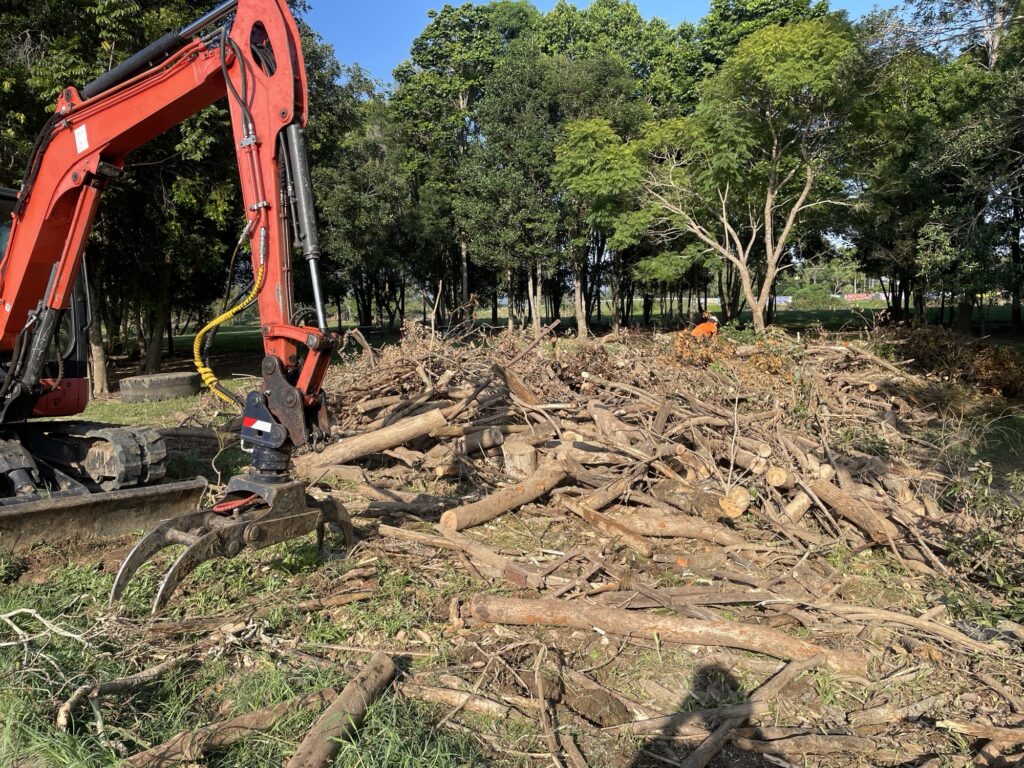
Less visible but equally damaging is soil compaction within root zones. Heavy equipment operating within the TPZ compresses soil, reducing oxygen availability and water infiltration to the root system. Compaction damage may not become apparent for months or years after construction.
Common causes of compaction damage include:
- Equipment tracking across unprotected root zones
- Material storage within TPZ boundaries
- Repeated vehicle access through root zones
- Staff pedestrian traffic concentrated in root areas
Grade Changes and Drainage Impacts
Altering soil levels within the TPZ — whether raising or lowering — affects root function. Fill over root zones can suffocate roots by restricting oxygen, while excavation removes soil and roots necessary for tree survival.
Grade changes also affect drainage patterns. Directing stormwater toward or away from root zones changes water availability that trees depend on. Our civil drainage installation team considers these impacts when designing surface and subsurface drainage near retained trees.
The Brisbane City Council stormwater drainage guidelines include provisions for maintaining appropriate drainage to protected vegetation during development.
Chemical Contamination
Construction sites present multiple contamination risks to root zones:
- Fuel and oil spills from equipment
- Concrete washout contaminating soil pH
- Chemical storage within or near TPZ
- Herbicide overspray during vegetation management
- Construction waste disposal within root zones
Damage Prevention Through Planning
Preventing tree damage starts during project planning, not on the day excavation begins. Effective strategies include:
- Engaging arborists during design development phase
- Adjusting building footprints to avoid significant TPZ encroachment
- Planning access routes that avoid root zones
- Identifying alternative service connection routes
- Scheduling works to minimise cumulative impacts
Learn more about our team and how we integrate vegetation protection into civil construction planning across South Brisbane and SEQ.
Working with an Arborist on AS 4970 Compliance
Effective collaboration between civil contractors and consulting arborists produces better outcomes for both construction projects and tree protection. Understanding what arborists provide — and what they need from contractors — streamlines the compliance process.
When Arborist Engagement Is Required
Arborist involvement becomes mandatory in several circumstances:
- Development approval conditions requiring arboricultural assessment
- Major encroachment proposed within any retained tree’s TPZ
- Any works proposed within calculated SRZ boundaries
- Trees protected under local government vegetation management laws
- Significant trees identified in planning scheme overlays
- Removal applications for regulated vegetation
Beyond mandatory requirements, early arborist engagement often prevents expensive design changes later. An Arboricultural Impact Assessment during design development identifies constraints before detailed engineering proceeds.
Types of Arborist Reports for Construction
Different project stages require different arborist documentation:
| Report Type | Project Stage | Primary Purpose |
|---|---|---|
| Arboricultural Impact Assessment | Development application | Assess development impact on trees, recommend retention/removal |
| Tree Protection Management Plan | Pre-construction | Specify protection measures, encroachment management |
| Root Investigation Report | Detailed design | Map root location for design coordination |
| Arborist Supervision Report | During construction | Document compliance, approve encroachment works |
| Tree Bond Assessment | Post-construction | Confirm tree survival for bond release |
Information Civil Contractors Should Provide
Arborists develop accurate recommendations when contractors provide comprehensive project information:
- Site survey including tree locations and sizes
- Proposed building footprints and finished levels
- Service connection requirements and preferred routes
- Access requirements during and after construction
- Construction methodology and equipment to be used
- Project timeline and staging information
This collaborative approach allows arborists to provide practical recommendations that acknowledge construction requirements while protecting trees. Our team at Dynamic Earth Solutions maintains close working relationships with our sister company, Dynamic Tree Solutions, ensuring seamless coordination between civil works and arboricultural requirements.
Arborist Supervision During Works
For sensitive works within TPZ boundaries, arborist supervision may be required as a condition of approval. Supervision ensures:
- Excavation proceeds within approved limits
- Root cutting uses appropriate techniques (hand tools, clean cuts)
- Unexpected root encounters are properly managed
- Compliance documentation is accurately completed
- Remedial treatment is applied where necessary
The Queensland Building and Construction Commission expects licensed contractors to comply with approval conditions including arborist supervision requirements.
Council Enforcement and Penalties
Local councils across South Brisbane actively enforce tree protection requirements. Understanding enforcement mechanisms helps contractors avoid costly penalties and project delays.
Brisbane City Council Enforcement
Brisbane City Council employs compliance officers who investigate potential breaches of vegetation protection conditions. Enforcement actions may include:
- Stop-work orders halting all construction until compliance is achieved
- Remediation orders requiring damaged tree treatment or replacement
- Penalty infringement notices for specific breaches
- Court prosecution for serious or repeated offences
- Bond forfeiture where tree protection bonds were required
Understanding Brisbane City Council tree regulations is essential for any contractor working within the Brisbane local government area.
Penalty Framework
Penalties for tree protection breaches vary based on severity and tree significance:
| Breach Type | Typical Penalty Range | Additional Consequences |
|---|---|---|
| TPZ fencing failure | $500–$2,500 | Remediation order |
| Unauthorised TPZ encroachment | $2,500–$10,000 | Tree assessment, possible replacement |
| Damage to protected tree | $5,000–$50,000 | Replacement planting, ongoing maintenance |
| Unlawful removal of significant tree | $50,000–$200,000+ | Prosecution, replacement at maturity value |
Penalty amounts vary between councils. Logan City Council planning and Ipswich City Council planning departments administer similar enforcement frameworks within their jurisdictions.
Due Diligence Defence
Contractors may avoid penalties by demonstrating due diligence in tree protection. Evidence supporting a due diligence defence includes:
- Documented review of approval conditions before works commenced
- Engagement of qualified arborists for required assessments
- Installation and maintenance of specified protection measures
- Staff training on tree protection requirements
- Prompt reporting and remediation of any accidental damage
At Dynamic Earth Solutions, our systematic approach to compliance documentation protects both our clients and our business from enforcement action. View our complete civil services list to understand the range of works we coordinate with tree protection requirements.
Civil Contractor TPZ Compliance — Best Practice Approaches
Beyond minimum compliance, experienced civil contractors adopt practices that streamline tree protection while maintaining construction efficiency. These approaches reflect lessons learned across hundreds of projects.
Pre-Construction Planning
Effective tree protection begins during tender and planning phases:
- Review all development approval conditions for vegetation requirements
- Identify all trees requiring retention and protection
- Calculate TPZ and SRZ boundaries using AS 4970 methodology
- Overlay protection zones on construction drawings
- Identify potential conflicts between protection zones and proposed works
- Coordinate with arborists for encroachment assessments where required
- Prepare Tree Protection Management Plan before site establishment
Before any excavation begins, contractors should verify underground services through Dial Before You Dig Australia to identify constraints that may affect both services protection and tree protection planning.
Site Establishment Sequence
The sequence of site establishment activities directly affects tree protection outcomes:
- Install tree protection fencing before any other site establishment works
- Establish site access routes avoiding TPZ boundaries
- Position site sheds, amenities, and storage outside protection zones
- Install ground protection before any required TPZ access
- Brief all site personnel and subcontractors on protection requirements
- Display TPZ plans at site entry points
- Establish inspection and maintenance schedules for protection measures
Modified Construction Techniques
When works must proceed near protected trees, modified techniques minimise damage:
- Hydro excavation: Non-destructive method for exposing roots during service installation
- Hand excavation: Required within SRZ to carefully work around roots
- Directional boring: Install services beneath root zones without trenching
- Pier foundations: Minimise excavation footprint near trees
- Suspended slabs: Avoid grade changes within root zones
Our hole boring and pile boring services include directional drilling capabilities that enable service installation with minimal root zone disturbance.
Documentation and Record Keeping
Comprehensive documentation protects contractors and provides evidence of compliance:
- Pre-construction tree condition assessment photographs
- As-installed fencing location records
- Ground protection installation evidence
- Site inspection logs with dates and findings
- Arborist supervision reports for encroachment works
- Post-construction tree condition assessment
- Handover documentation to client or ongoing manager
Tree Protection Zone Civil Works — Project Type Considerations
Different project types present different tree protection challenges. Understanding these variations helps contractors anticipate requirements and plan accordingly.
Commercial and Industrial Developments
Large commercial sites in areas like Yatala, Richlands, and Wacol often involve extensive earthworks that may conflict with retained vegetation. Key considerations include:
- Larger equipment requiring wider access routes
- More extensive cut and fill operations
- Complex stormwater management requirements
- Multiple service connections across the site
- Staging requirements that may affect protection zones at different phases
Our site levelling and grading services for commercial projects incorporate tree protection requirements into bulk earthworks planning.
Residential Subdivision
Subdivision projects across South Brisbane suburbs like Calamvale, Parkinson, and Drewvale frequently retain trees within road reserves, parks, and individual lots. Considerations include:
- Road construction near street tree locations
- Service installation through multiple protection zones
- Stormwater infrastructure potentially affecting trees
- Individual lot access requirements
- Retained trees becoming assets for future lot owners
Infrastructure Projects
Linear infrastructure including roads, utilities, and drainage often traverses areas with protected vegetation. These projects require careful alignment design to minimise tree impacts while achieving infrastructure objectives.
Working with the QLD Department of State Development planning on significant projects often involves coordinated approaches to vegetation management across state and local government requirements.
Remediation and Disaster Recovery
Storm damage events can create complex situations where tree protection requirements intersect with urgent remediation needs. Our emergency civil works Queensland and disaster recovery services include protocols for protecting retained trees while addressing immediate hazards.
In these situations, coordination with the Queensland Reconstruction Authority may establish modified requirements that balance recovery urgency with vegetation protection.
Frequently Asked Questions
What is AS 4970 and why does it apply to my construction project?
AS 4970:2009 is the Australian Standard titled “Protection of trees on development sites” that establishes methods for calculating tree protection zones and managing construction activities near retained trees. While the standard itself isn’t legislation, it becomes legally binding when referenced in your development approval conditions, council requirements, or construction contracts. Most local councils across South Brisbane and SEQ require compliance with AS 4970 as a condition of development approval for any site containing trees to be retained. Failure to comply can result in stop-work orders, financial penalties, and requirements to remediate damaged trees or provide replacement plantings at substantial cost.
How do I calculate the Tree Protection Zone for a tree on my development site?
The standard AS 4970 formula for calculating TPZ radius is: DBH (in metres) × 12 = TPZ radius (in metres). DBH means Diameter at Breast Height, measured at 1.4 metres above ground level. For example, a tree with a 40cm diameter (0.4m) would have a TPZ radius of 4.8 metres. The standard specifies a minimum TPZ radius of 2 metres regardless of calculated result, and a maximum of 15 metres unless an arborist assessment determines otherwise. For multi-stemmed trees, calculate combined DBH from all stems. Where trees have significant buttress roots, measure diameter above the buttress flare.
What is the difference between TPZ and SRZ, and why does it matter for excavation?
The Tree Protection Zone (TPZ) represents the area around a tree where soil and root disturbance should be minimised to maintain tree health. The Structural Root Zone (SRZ) is a smaller area specifically protecting roots essential for tree stability — the roots that prevent the tree from falling over. While some TPZ encroachment may be acceptable under certain conditions, SRZ encroachment is almost always unacceptable because it directly threatens structural integrity. From a civil contractor’s perspective, the SRZ represents an absolute boundary for excavation, while the TPZ boundary may be negotiable with appropriate arborist assessment and modified construction techniques.
Can I proceed with excavation within a Tree Protection Zone without an arborist report?
This depends on the extent of encroachment and your development approval conditions. Minor encroachment affecting less than 10% of total TPZ area may proceed without formal arborist assessment, provided works are outside the SRZ, ground protection is installed, and other AS 4970 requirements are met. Major encroachment exceeding 10% of TPZ area requires formal arborist assessment before works proceed. Additionally, many development approvals specifically require arborist reports regardless of encroachment level, and some council-protected trees require arborist involvement for any works within the TPZ. Review your approval conditions carefully — if in doubt, obtain consulting arborist reports before proceeding.
What happens if I accidentally damage a protected tree during civil works?
Accidental damage should be reported immediately — both to the project manager and, where relevant, to the certifying arborist and council. Prompt reporting and remediation demonstrates due diligence and may mitigate penalties. Remedial actions might include proper wound treatment, adjusted watering regimes, root treatment, or modified construction approaches to prevent further damage. Councils may require ongoing monitoring to assess tree response to damage. If damage is severe and tree survival is compromised, replacement requirements may apply, potentially including offset planting or payment towards council’s urban forest programs. Prevention through proper planning and protection measures is always preferable to managing consequences of damage.
What type of fencing is required for tree protection zone compliance?
AS 4970 specifies minimum fencing requirements including: minimum 1.8 metres height; self-supporting structure stable under construction site conditions; chain wire mesh, welded mesh, or solid panel construction; and clear “Tree Protection Zone — No Entry” signage at regular intervals. Fencing must be positioned at or beyond the calculated TPZ radius unless arborist assessment permits reduced setbacks. The fencing must remain in place and maintained throughout construction until practical completion or until the certifying arborist approves removal. Any temporary removal for access must be approved and minimised in duration, with ground protection measures installed before any entry.
How do I install underground services through a tree protection zone without damaging roots?
Several techniques enable service installation with minimal root damage. Directional boring or horizontal directional drilling passes beneath root zones without trenching. Hydro excavation uses pressurised water to expose roots without cutting, allowing services to be carefully threaded between roots. Where trenching is unavoidable, hand excavation within the TPZ allows roots to be identified and avoided or cleanly cut rather than torn by machinery. Routing alternatives should always be considered first — redesigning service alignments to avoid TPZ boundaries is often more cost-effective than modified construction techniques. An Arboricultural Impact Assessment can identify the most appropriate technique for your specific site conditions.
What penalties apply for damaging council-protected trees in Brisbane?
Brisbane City Council penalties for tree protection breaches range from infringement notices of several hundred dollars for minor compliance failures, up to court-imposed fines exceeding $200,000 for unlawful removal of significant trees. Typical penalties include: $500–$2,500 for fencing non-compliance; $2,500–$10,000 for unauthorised TPZ encroachment; $5,000–$50,000 for damage to protected trees; and $50,000+ for unlawful removal. Beyond financial penalties, remediation orders may require replacement planting at maturity value — for large significant trees, this can exceed the direct financial penalty. Stop-work orders halting entire projects while compliance is achieved impose additional indirect costs through delays.
Do I need an arborist on site during excavation near protected trees?
Arborist supervision requirements depend on your development approval conditions and the nature of works proposed. Common situations requiring on-site arborist supervision include: excavation within the outer 50% of the TPZ; any works within or near the SRZ; root cutting or pruning of roots greater than specified diameters; installation of services requiring trenching through root zones; and works near trees of exceptional significance. Review your approval conditions for specific supervision requirements. Even where supervision isn’t mandated, having an arborist available for consultation when unexpected root encounters occur can prevent costly mistakes and compliance issues.
How does Dynamic Earth Solutions coordinate civil works with tree protection requirements?
At Dynamic Earth Solutions, we integrate tree protection into project planning from tender stage. Our process includes reviewing all approval conditions for vegetation requirements, coordinating with our sister company Dynamic Tree Solutions for arboricultural assessments, overlaying TPZ boundaries on construction drawings, identifying conflicts and coordinating design modifications where needed, and establishing protection measures as the first site establishment activity. Our indigenous-owned business — registered with Supply Nation — brings cultural understanding of environmental stewardship alongside technical construction expertise. Contact our team to discuss how we can deliver your civil works while maintaining tree protection compliance.
What qualifications should I look for when engaging an arborist for AS 4970 compliance?
For AS 4970 compliance work, engage an AQF Level 5 consulting arborist with specific experience in construction site tree assessment. AQF Level 5 (Diploma of Arboriculture) represents the consulting arborist qualification level appropriate for preparing reports, developing management plans, and certifying compliance. Check that the arborist carries appropriate professional indemnity insurance and can provide references from similar construction projects. They should be familiar with local council requirements across South Brisbane and SEQ, and able to communicate effectively with civil contractors and project managers. Membership in professional organisations such as Arboriculture Australia provides additional confidence in professional standards.
Can I remove trees within a tree protection zone if they obstruct construction?
Tree removal within protection zones typically requires formal approval, either through your original development application or a subsequent application to council. The development assessment process considers tree significance, health, location, and whether retention is practical given approved development parameters. If trees were identified for retention in your approval, removal will require formal amendment and may trigger additional conditions including offset planting or contributions. For trees not captured by council regulations, removal may proceed but still requires consideration of impacts on adjacent protected trees whose root systems may extend into the area. Always verify approval status before proceeding with any tree removal — our sister company provides professional tree removal Brisbane services where removal is appropriately approved.
How long do tree protection measures need to remain in place during construction?
Tree protection measures must remain in place throughout construction until practical completion of all works that could affect retained trees. This typically means protection stays until external works including landscaping are substantially complete. Specific timing depends on your approval conditions — some require arborist certification before protection removal, others specify protection must remain until final inspection or certificate of occupancy. Premature removal of protection exposes trees to damage from late-stage works including landscaping, external works, and client handover activities. Where projects involve multiple stages, protection may need progressive adjustment as each stage completes while subsequent stages continue.
Partner With Experts in Civil Works Near Protected Trees
Successfully delivering civil construction projects while maintaining AS 4970 tree protection compliance requires experience, planning, and collaboration between civil contractors and qualified arborists. At Dynamic Earth Solutions, we bring both capabilities together through our partnership with Dynamic Tree Solutions.
As an indigenous-owned civil contractor operating across South Brisbane and SEQ, we understand that development and environmental stewardship aren’t opposing forces — they’re complementary aspects of responsible construction. Our indigenous-owned story reflects a commitment to working with country, not against it.
Whether you’re planning commercial development in Richlands, residential subdivision in Parkinson, or infrastructure works across Logan, our integrated approach ensures your project meets tree protection requirements while maintaining construction efficiency.
Ready to discuss your next project? Contact our team for expert guidance on civil works that achieve both construction objectives and environmental compliance. Explore our blog for more technical insights, or review our frequently asked questions for additional information about our services.