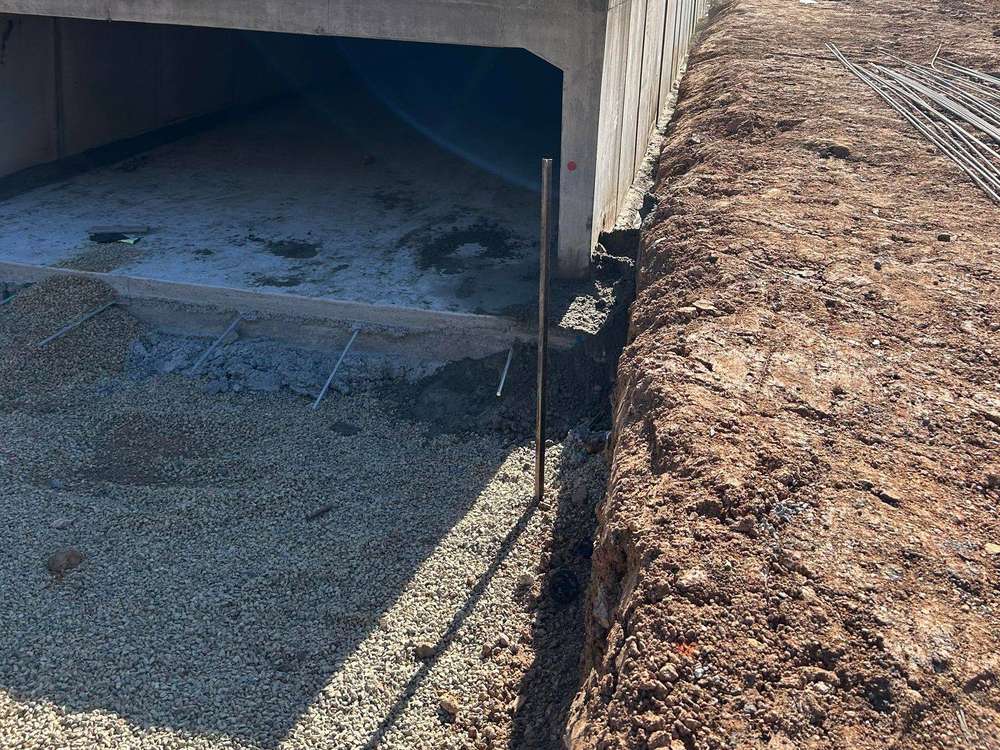
Short answer: On a Brisbane block the stormwater is your problem until it reaches a lawful point of discharge, which is usually the kerb and channel or a Council drain on your own frontage. Brisbane City Council says the owner is responsible for the private stormwater lines, roof gutters, tanks and subsoil drains should all connect to that lawful point, and water should not be sent onto the ground or into a neighbour’s yard. Connecting to the kerb or a Council drain needs a Council application, and anything crossing a neighbour’s land needs their written consent.
The rest of this post is what those rules mean when there is an excavator on the block, who approves what, and what a drainage install on a house site actually involves. If you want the service rather than the reading, our drainage and stormwater page covers what we dig across Brisbane’s south and south-west, Logan and Ipswich.
Who is responsible for stormwater on a Brisbane block?
The owner. Council’s stormwater runoff and drainage page is blunt about it: owners are responsible for private stormwater lines, for installing and maintaining the pipes, gutters and downpipes, for keeping drains clear of debris and for maintaining any easements on the land. Council is not responsible for private stormwater lines even where they run across Council land.
The other thing that page makes clear is that Council does not referee water between neighbours. You cannot complain to Council about natural runoff from the block next door; it is a civil matter, and Council’s advice is to talk to the neighbour first and go to neighbourhood mediation if that fails. What Council does investigate is pollution: soil, silt, concrete slurry and building waste leaving a site and getting into a drain or a creek. That is the part that lands on the builder and the earthworks contractor, and it is why we treat erosion and sediment control as part of every dig.
What is a lawful point of discharge?
Council describes lawful points of discharge as the requirements for managing stormwater on a site, which vary by development type and have to meet Council’s standards under its infrastructure design planning scheme policy. In plain terms it is the place your stormwater is allowed to end up. Council recommends connecting the system to a Council drain or the road on your own site. If the only way out is through a neighbour’s property, you need the owner’s permission, and on a new build that generally means a registered drainage easement, not a handshake.
The age of the house matters. Council says houses built after 1975 must drain stormwater to an approved outlet such as the Council stormwater main or the kerb and channel, and points owners to an accredited building certifier for the connection rules. For houses built in or before 1975, connecting to a lawful point such as the kerb is recommended, and becomes mandatory if the site is redeveloped or the old line fails and you want a new way out.
Searches for stormwater drainage Brisbane City Council rules usually come from one of two places: a block being redeveloped, where the certifier has asked where the water goes, or a backyard that has turned into a pond. Both end up at the same question, which is where the lawful point is and how the pipe gets there.
Do you need Council approval to connect stormwater?
For the connection itself, yes, and that is the part of stormwater drainage Brisbane City Council actually signs off on. Council’s page on building over or near stormwater and drainage infrastructure says connecting stormwater or roofwater pipes to the kerb and channel, an open drain, a swale, enclosed drainage, a stormwater gully or a culvert all need an Application or Notice to Work on Council Property. Building over or close to a Council stormwater line needs a referral agency response under the Queensland Development Code, and if the line sits in a drainage easement you need the easement owner’s consent and copies of the easement plans. Where Council owns the easement, the consent has to be in hand before you lodge.
Two other things from the same page are worth knowing before the machine arrives. Council’s drainage plans may show private roofwater lines for houses, and the as-constructed hydraulic plans usually show them for commercial and multi-unit sites, so ask for the plans before anyone guesses where the old pipe runs. And anything to do with sewer or water mains is Urban Utilities, not Council. We lodge a Before You Dig enquiry on every job for the same reason: the plans tell you what is there, the dig tells you where it actually is.
Logan and Ipswich run their own planning schemes and their own stormwater standards. Our post on drainage installation under Logan City Council covers that side of the boundary.
What about overland flow?
Overland flow is the water that runs across the surface when the pipes are full or there are no pipes, and on the flats around Coopers Plains, Rocklea and Archerfield it is the thing that decides whether a block is buildable. Council’s drainage page lists overland flow easements among the infrastructure to check before you build, alongside Council and private stormwater lines. Check the property in City Plan online for flood and overland flow overlays before you plan a cut, a fill or a shed slab, because filling across an overland flow path moves the water onto someone else, and that is where the civil disputes start.
On sloping blocks in Holland Park and Wishart the problem is the opposite: water arriving from uphill at speed. A cut-off drain on the high side, surface grades that push water around the house instead of under it, and a subsoil drain behind any retaining wall are the standard answers.
What does a drainage install involve on a block?
Most of what we do is the trench, the bedding, the pipe and the backfill, with a licensed plumber or drainer doing the connection and certification where the rules require it. A typical house job runs like this:
- Plan. The hydraulic plan or the plumber’s layout sets the pipe sizes, pits and grades. The lawful point is confirmed before anything is dug.
- Locate. Before You Dig plans, Council drainage plans, and potholing by hand where the old line, the sewer or the power are close.
- Sediment control. Silt fence on the low side, spoil kept off the footpath and out of the gutter.
- Trench. The excavator opens the line to the depth and grade on the plan. Clay holds a trench wall well when it is dry and badly when it is wet, so the trench is opened in the order the pipe can go in, not all at once.
- Bed, lay, test. Gravel bedding, pipe laid to grade with the joints and pits where the plan says, then the plumber’s test where one is required.
- Backfill and compact. In layers, with the top dressed so the surface still falls toward the drain, not toward the house.
- Connect. The kerb or Council drain connection goes in under the Council permit, by whoever the permit names.
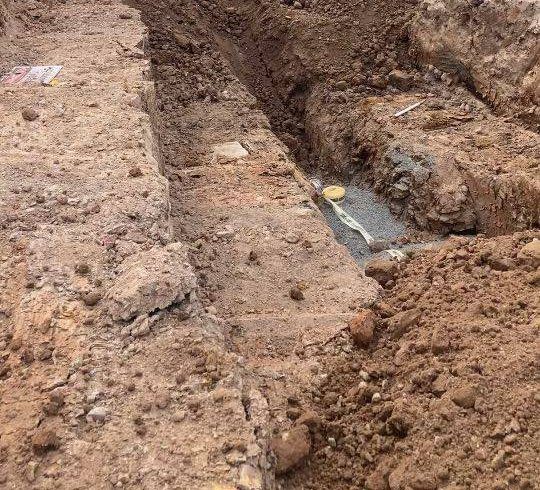
Tree roots are the one thing the plans never show. An old earthenware line with a fig or a camphor laurel over it is usually full of root, and digging it out without looking at the tree first is how you end up with a dead tree and a Council letter. The arborists at Dynamic Tree Solutions, our sister company next door in Forest Lake, look at the tree before we open the ground near it.
What drives the cost of stormwater drainage?
We do not publish a rate card for drainage, because the pipe is the cheap part. What moves the number:
- Length and depth of trench. Deeper trenches in clay are slower and need more bedding and more backfill.
- Distance to the lawful point. A kerb connection on your own frontage is one thing; an easement across the neighbour’s yard is another job entirely, with its own paperwork.
- What is in the way. Rock, old fill, existing services, tree roots, a driveway that has to be cut and reinstated.
- Pits, sumps and grates. Every change of direction and every low point needs one.
- Permits and certification. The Council application for the connection, the plumber’s certification, the easement if one is needed.
- Access and spoil. Whether the machine can reach the trench line and whether the spoil can stay on site or has to leave in the tipper.
If the drainage is going in alongside the footings and trenches for a new build, the set-up, the sediment controls and the float are already on site and you pay for them once.
Send the address, the hydraulic plan if there is one and a few photos of where the water pools, and we will quote it with the drivers listed. Call 0424 168 352 or use the quote form.
Frequently asked questions
What does stormwater drainage Brisbane City Council involve?
Getting the water from your roof, yard and subsoil drains to a lawful point of discharge, usually the kerb and channel or a Council drain on your own frontage, through private pipes that you own and maintain. Connecting to the kerb or a Council drain needs an Application or Notice to Work on Council Property, and crossing a neighbour's land needs their consent.
Do I need council approval for stormwater drainage?
For the connection to Council infrastructure, yes: kerb and channel, open drains, swales, gullies and culverts all need a Council application. Building over or near a Council stormwater line needs a referral agency response under the Queensland Development Code. The private pipes on your block are a building and plumbing matter, so talk to the certifier and a licensed plumber.
Can I drain my stormwater onto the ground or into the neighbour's yard?
No. Brisbane City Council says owners should avoid draining stormwater directly onto the ground, and water sent across a neighbour's land needs the owner's permission, generally through an easement. Council does not investigate natural runoff disputes between neighbours; it treats them as a civil matter.
How long does a stormwater drainage install take?
A house-block drainage run is usually one to three days of digging and laying once the plan, the Before You Dig plans and the Council permit are in hand. The permit and the plumber's certification are what set the program, not the trench.
What is an overland flow path and why does it matter?
It is the route surface water takes across a block when the drains are full or there are none. Council lists overland flow easements among the drainage infrastructure to check before you build, and flood and overland flow overlays in City Plan can limit filling and building. Filling across a flow path pushes the water onto someone else.
What areas do you cover for drainage work?
Brisbane's south and south-west, Logan City and Ipswich City. Our yard is at Ellen Grove next to Forest Lake, so Coopers Plains, Holland Park, Wishart, Forest Lake and the suburbs between are short runs. Commercial and civil drainage further out is by quote.