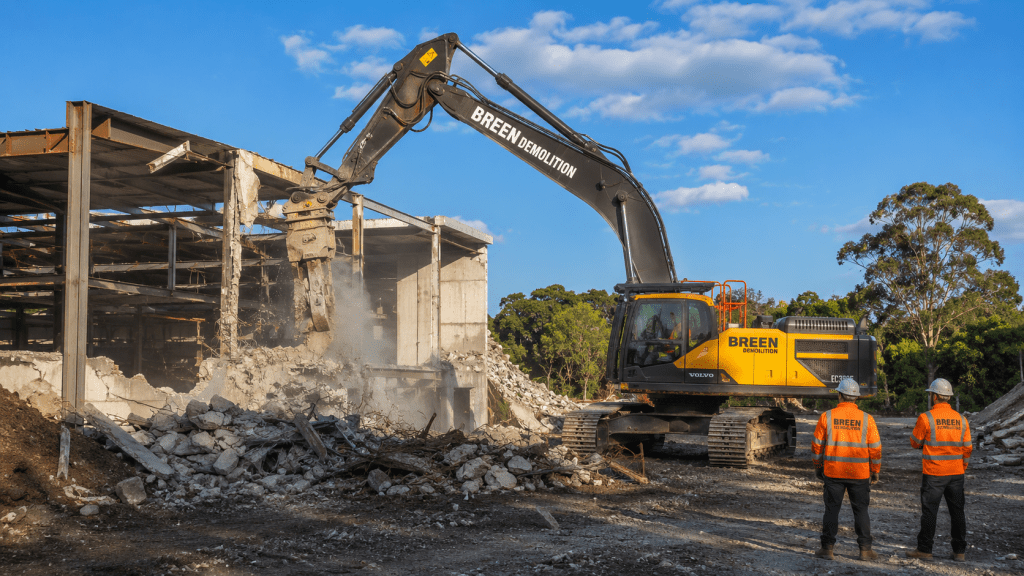
Commercial Demolition Brisbane — Overview
Commercial demolition Brisbane projects demand meticulous planning, regulatory compliance, and coordination across multiple disciplines. Whether you’re demolishing a warehouse in Acacia Ridge, an office complex in Rocklea, or industrial facilities in Coopers Plains, understanding the complete process ensures your project proceeds without costly delays or compliance failures.
Dynamic Earth Solutions delivers comprehensive commercial demolition and excavation services throughout South Brisbane and South-East Queensland. As an indigenous-owned civil contractor registered with Supply Nation, we bring both technical expertise and ethical business practices to every demolition project.
This guide covers everything developers, builders, and project managers need to know about commercial demolition in Brisbane for 2026 — from licensing requirements and asbestos considerations to cost factors and timeline expectations.
What Constitutes Commercial Demolition?
Commercial demolition encompasses the systematic dismantling or destruction of non-residential structures. This includes:
- Office buildings and commercial complexes
- Retail premises and shopping centres
- Warehouses and distribution centres
- Industrial facilities and factories
- Hotels, motels, and hospitality venues
- Educational and healthcare facilities
- Multi-unit residential developments (Class 2-9 buildings)
Unlike residential demolition, commercial projects typically involve larger structures, complex utility disconnections, and stricter regulatory oversight under the Queensland Building and Construction Commission framework.
South Brisbane Commercial Demolition Demand
South Brisbane’s industrial corridors are experiencing significant redevelopment activity. Suburbs including Salisbury, Moorooka, Yeerongpilly, and Coorparoo are seeing older commercial stock replaced with modern mixed-use developments. This urban renewal creates substantial demand for experienced commercial demolition contractors who understand local conditions.
The Brisbane 2032 Olympic Games preparations are accelerating infrastructure upgrades across South-East Queensland, driving commercial demolition activity in areas like Woolloongabba, South Brisbane proper, and surrounding precincts.
Licensed Demolition Requirements in Commercial Demolition Brisbane
Queensland law mandates specific licensing for demolition work. Understanding these requirements protects project owners from liability and ensures work meets safety standards.
QBCC Licensing Categories
The Queensland Building and Construction Commission administers demolition licensing through several categories:
| License Class | Scope of Work | Structural Limitations |
|---|---|---|
| Demolisher — Low Rise | Buildings up to 3 storeys | Excludes pre-stressed concrete |
| Demolisher — Medium Rise | Buildings up to 15 metres | Includes pre-stressed elements |
| Demolisher — Open | Any building height | No restrictions |
| Builder — Low Rise | Incidental demolition only | Part of broader construction |
Commercial projects typically require Medium Rise or Open class licensees, particularly for multi-storey structures or those containing pre-stressed concrete elements common in warehouse and industrial buildings.
Contractor Verification
Before engaging any commercial demolition contractor, verify their credentials through:
- QBCC license search — Confirm active license status and appropriate class
- Public liability insurance — Minimum $20 million coverage recommended for commercial projects
- Workers’ compensation currency — Essential for on-site workforce protection
- WorkCover Queensland compliance — Active registration and premium currency
- Asbestos removal licensing — Class A or B as required for hazardous materials
At Dynamic Earth Solutions, we maintain comprehensive licensing and insurance coverage. Our commitment to safety and compliance standards ensures every project meets regulatory requirements.
Safe Work Method Statements
Commercial demolition constitutes high-risk construction work under WorkSafe Queensland regulations. Principal contractors must maintain Safe Work Method Statements (SWMS) for all demolition activities.
SWMS documentation must address:
- Structural assessment and demolition sequencing
- Fall prevention and edge protection
- Hazardous material management procedures
- Plant and equipment operation protocols
- Emergency response procedures
- Public protection measures
Asbestos and Hazmat Considerations
Asbestos demolition Brisbane projects require heightened attention to hazardous material identification and removal. Commercial buildings constructed before 1990 frequently contain asbestos-containing materials (ACMs) in various locations.
Asbestos Survey Requirements
Queensland legislation mandates hazardous materials surveys before demolition of commercial buildings. A qualified occupational hygienist must conduct comprehensive assessments identifying:
- Friable asbestos in insulation, fireproofing, and spray-applied coatings
- Non-friable asbestos in cement sheeting, vinyl flooring, and roof materials
- Lead-based paints on structural elements and fixtures
- Synthetic mineral fibres in insulation systems
- PCBs in electrical transformers and capacitors
- Ozone-depleting substances in refrigeration and air conditioning
Asbestos Removal Licensing
Queensland recognises two classes of asbestos removal licensing:
| License Class | Material Type | Quantity Limits | Typical Applications |
|---|---|---|---|
| Class A | Friable and non-friable | No limit | Commercial building demolition |
| Class B | Non-friable only | No limit (>10m² requires Class A) | Residential, minor commercial |
Commercial demolition projects in South Brisbane frequently require Class A licensed removalists, particularly for industrial buildings with complex asbestos installations.
Notification and Clearance Requirements
Asbestos removal exceeding 10 square metres requires notification to WorkSafe Queensland at least five days before work commences. Licensed assessors must provide clearance certificates before demolition proceeds.
Demolition contractors must ensure complete asbestos removal and clearance before mechanical demolition begins. This sequencing protects workers and prevents fibre release during structural dismantling.
Hazmat Cost Implications
Hazardous material presence significantly impacts commercial demolition cost Brisbane project budgets. Asbestos removal typically adds $50-150 per square metre depending on material type and accessibility. Complex friable asbestos removal in confined spaces may exceed $300 per square metre.
Early identification through pre-purchase surveys allows developers to factor these costs into acquisition decisions and project feasibility assessments.
Demolition Permit Process (BCC)
Demolition permits Brisbane applications follow specific pathways depending on building characteristics and heritage status. Brisbane City Council planning and development administers the approval process.
Residential owners on the southside can see the same approval pathways applied to houses in our guide to demolition permits on Brisbane’s southside.
Permit Categories
Brisbane City Council recognises several demolition approval pathways:
- Self-assessable demolition — Buildings with no heritage overlay, not character housing, under specific criteria
- Code-assessable applications — Standard commercial buildings without complicating factors
- Impact-assessable applications — Heritage-listed buildings, significant structures, or sensitive locations
Most commercial demolition Brisbane projects follow code-assessable pathways, though character precinct locations may trigger impact assessment requirements.
Application Documentation
Commercial demolition permit applications require comprehensive documentation:
- Site plan — Showing building footprint, boundaries, and adjacent structures
- Structural engineering report — Confirming demolition methodology safety
- Hazardous materials survey — Documenting ACMs and other hazmat presence
- Asbestos removal control plan — If applicable, detailing removal methodology
- Traffic management plan — For works affecting public roadways
- Environmental management plan — Addressing dust, noise, and stormwater protection
- Tree assessment report — Required when significant vegetation exists on site
When protected vegetation exists on commercial sites, consulting arborist reports become mandatory components of demolition applications. Our sister company, Dynamic Tree Solutions, provides these assessments through their AQF Level 5 consulting arborist team.
Timeline Expectations
Council assessment timeframes vary by application type:
| Application Type | Statutory Period | Typical Actual Timeframe |
|---|---|---|
| Self-assessable | N/A — Compliance-based | Immediate (with documentation) |
| Code-assessable | 25 business days | 15-30 business days |
| Impact-assessable | Variable | 60-120+ business days |
Information requests extend these timeframes. Complete applications with professional documentation typically achieve faster approvals.
Conditions of Approval
Demolition permits typically include conditions addressing:
- Working hours restrictions (typically 6:30am-6:30pm Monday-Saturday)
- Dust and noise control measures
- Sediment and erosion control requirements
- Public notification requirements for major demolition
- Utility disconnection verification
- Site hoarding and public safety measures
- Tree protection requirements for retained vegetation
Combined Demolition and Excavation
Commercial demolition and excavation services deliver significant efficiencies when coordinated under single project management. This integrated approach minimises mobilisation costs, reduces handover complications, and accelerates overall project timelines.
Integrated Project Benefits
Combining demolition with subsequent excavation offers multiple advantages:
- Single mobilisation — Plant and equipment arrives once for extended engagement
- Continuous workflow — No gap between demolition completion and excavation commencement
- Unified project management — Single point of accountability throughout site preparation
- Material handling efficiency — Demolition spoil and excavated material managed cohesively
- Reduced administration — Fewer contracts, invoices, and coordination requirements
Our complete civil services list encompasses both demolition and excavation capabilities, enabling true single-contractor delivery.
Demolition to Excavation Sequencing
Professional sequencing ensures efficient transition from demolition to excavation phases:
- Structure demolition — Systematic dismantling of above-ground elements
- Slab breaking — Removal of ground floor slabs and footings
- Underground structure removal — Extraction of basements, pits, and sub-surface elements
- Service identification — Dial Before You Dig verification before bulk excavation
- Bulk excavation — Major earth movement to design levels
- Detailed excavation — Precise formation for footings and services
Our bulk and detailed excavations services follow established methodologies compliant with AS 3798 earthworks guidelines.
Site Preparation Continuum
Following demolition and excavation, commercial projects typically require additional site preparation works:
- Site levelling and grading — Establishing finished surface levels
- Civil drainage installation — Stormwater and sewer connections
- Footings and trenches — Foundation preparation works
- Concrete and slab preparation — Subgrade compaction and boxing
Coordinating these activities under single contractor management delivers project certainty and accountability.
Tree Removal Before Demolition
Demolition tree removal Brisbane projects require careful sequencing to ensure vegetation clearing occurs before structural demolition begins. Trees and vegetation must be addressed early in the demolition process for safety, efficiency, and regulatory compliance reasons.
Why Pre-Demolition Tree Removal Matters
Removing trees before structural demolition delivers several critical benefits:
- Access establishment — Tree removal opens site access for demolition plant
- Safety clearance — Eliminates falling branch hazards during demolition
- Service exposure — Reveals underground services obscured by root systems
- Dust control improvement — Removes vegetation trapping demolition dust
- Regulatory sequencing — Ensures tree removal approvals precede demolition permits
Our sister company provides commercial tree services specifically designed for pre-demolition applications. Their teams understand the integration requirements between vegetation removal and subsequent civil works.
Regulated Tree Assessment
Brisbane City Council’s vegetation protection regulations require assessment of significant trees before removal. Trees meeting the following criteria typically require approval:
- Trunk diameter exceeding 200mm at 1.3 metres above ground
- Located within mapped vegetation protection overlays
- Listed as heritage vegetation
- Identified as significant habitat trees
Dynamic Tree Solutions’ AQF-certified arborists in Brisbane conduct compliant assessments supporting demolition permit applications. Their Arboricultural Impact Assessment reports satisfy council requirements and document vegetation values.
Commercial Site Vegetation Clearing
Industrial and commercial sites often feature substantial vegetation requiring professional removal. Common scenarios include:
- Overgrown warehouse yards in Rocklea and Acacia Ridge
- Abandoned industrial sites in Salisbury and Moorooka
- Former hospitality venues in Sunnybank and Upper Mount Gravatt
- Derelict commercial properties across South Brisbane corridors
For sites requiring extensive vegetation clearance, land clearing Brisbane services provide efficient large-scale removal. This includes both tree removal and understorey vegetation clearing in preparation for demolition.
Hazardous Tree Situations
Deferred maintenance on commercial properties often results in hazardous tree conditions. Trees may have grown into structures, developed structural defects, or become unstable following neglect. These situations require hazardous tree clearing specialists with technical rigging capabilities.
Hazardous tree removal scenarios common to commercial demolition include:
- Trees growing through roof structures or awnings
- Large specimens with significant deadwood over work areas
- Storm-damaged trees with compromised structural integrity
- Trees with root systems undermining demolition sequencing
Early engagement of arboricultural specialists ensures tree removal doesn’t become a critical path delay for demolition timelines.
Stump Removal and Site Clearance
Complete site clearing for demolition requires stump removal following tree felling. Remaining stumps interfere with demolition plant movements and subsequent excavation works. Stump grinding services from Dynamic Tree Solutions remove below-ground obstructions efficiently.
For comprehensive vegetation removal preparing sites for demolition, professional tree removal Brisbane services deliver complete solutions from initial assessment through final stump removal.
Material Recycling and Disposal
Commercial demolition generates substantial material volumes requiring systematic management. Modern demolition practices emphasise material recovery and recycling over landfill disposal.
Material Categories and Handling
Commercial demolition produces diverse material streams:
| Material Category | Typical Recovery Rate | Destination |
|---|---|---|
| Concrete and masonry | 90-95% | Crushing and recycling for road base |
| Structural steel | 95-100% | Metal recycling facilities |
| Timber (untreated) | 70-80% | Mulching or biomass energy |
| Brick | 50-70% | Recycled brick supply or crushing |
| Plasterboard | 80-90% | Dedicated gypsum recycling |
| Asbestos materials | 0% | Licensed disposal facilities only |
Professional commercial demolition contractors maximise material recovery, reducing disposal costs and environmental impact.
Concrete Recycling
Concrete constitutes the largest material volume from most commercial demolition projects. Brisbane’s concrete recycling facilities process demolition concrete into:
- Road base material — Crushed concrete for pavement construction
- Drainage aggregate — Sized material for stormwater systems
- Fill material — General site filling applications
- Recycled concrete aggregate — Component in new concrete production
On-site crushing may prove economical for larger projects, particularly where crushed material can be reused for site works including building site preparation.
Metal Recovery
Structural steel, reinforcement, and non-ferrous metals represent valuable commodities recoverable from commercial demolition. Metal values partially offset demolition costs, with current market prices fluctuating based on global commodity markets.
Systematic separation during demolition maximises metal recovery values:
- Structural steel sections and beams
- Reinforcing bar from concrete elements
- Copper from electrical systems
- Aluminium from window frames and cladding
- Stainless steel from commercial kitchen fit-outs
Green Waste Processing
Vegetation cleared during demolition site preparation generates green waste requiring appropriate disposal. Dynamic Tree Solutions’ forestry mulching services process vegetation on-site where practicable, reducing transport costs and creating usable mulch products.
Our tree clearing for construction services coordinate vegetation removal with green waste management, ensuring efficient site preparation workflows.
Disposal Cost Management
Material disposal represents a significant cost component in commercial demolition. Strategic waste management reduces disposal expenses through:
- On-site sorting to maximise recyclable material separation
- Direct delivery to recycling facilities rather than transfer stations
- Timing demolition to optimise scrap metal market conditions
- Negotiating volume-based disposal agreements for large projects
Cost Factors and Quoting
Commercial demolition cost Brisbane projects vary significantly based on multiple factors. Understanding these variables enables realistic budgeting and informed contractor selection.
Primary Cost Drivers
Key factors influencing commercial demolition pricing include:
- Building size and construction type — Larger buildings and reinforced concrete structures cost more
- Height and complexity — Multi-storey buildings require specialised equipment and methods
- Hazardous materials presence — Asbestos and other hazmat significantly increase costs
- Site access constraints — Restricted access increases time and equipment requirements
- Neighbouring structures — Party wall situations require careful methodology
- Material disposal distances — Remote disposal facilities increase transport costs
- Vegetation extent — Significant trees and vegetation require pre-demolition removal
Indicative Pricing Ranges
Commercial demolition pricing typically falls within these ranges for South Brisbane projects:
| Building Type | Price Range (per m²) | Key Variables |
|---|---|---|
| Warehouse (steel frame) | $30-60/m² | Roof height, slab thickness |
| Warehouse (concrete tilt-up) | $45-80/m² | Panel size, footing complexity |
| Office building (1-2 storey) | $50-90/m² | Construction type, fit-out complexity |
| Office building (3+ storey) | $80-150/m² | Height access, structural system |
| Retail premises | $40-70/m² | Shopfront complexity, party walls |
| Industrial facility | $35-75/m² | Contamination, equipment removal |
These ranges exclude asbestos removal, which adds $50-300/m² depending on material type and extent. Always obtain project-specific quotations rather than relying on general pricing guides.
Quotation Components
Comprehensive commercial demolition quotes should detail:
- Scope definition — Clear description of structures included and excluded
- Methodology — Proposed demolition approach and sequencing
- Hazardous material handling — Specific pricing for asbestos and other hazmat
- Disposal costs — Material disposal and any recycling credits
- Provisional sums — Allowances for unforeseen conditions
- Program — Anticipated duration and key milestones
- Exclusions — Items not included in the quoted price
Contact our team for detailed quotations on commercial demolition projects throughout South Brisbane and South-East Queensland.
Value Engineering Opportunities
Cost reduction opportunities in commercial demolition include:
- Combining demolition with subsequent excavation under single contract
- Timing projects to align with quiet periods in the demolition market
- Maximising on-site material reuse where suitable
- Early engagement enabling efficient planning and resource allocation
- Flexible programming allowing contractor efficiency optimisation
Timeline Expectations
Commercial demolition project timelines depend on building characteristics, approval requirements, and site complexity. Realistic programming enables effective project coordination.
Typical Phase Durations
Commercial demolition projects progress through distinct phases:
| Phase | Duration Range | Key Activities |
|---|---|---|
| Pre-demolition assessment | 2-4 weeks | Surveys, hazmat testing, structural review |
| Permit approval | 3-8 weeks | Council assessment and approval |
| Asbestos removal | 1-4 weeks | Hazmat removal and clearance |
| Soft strip | 1-2 weeks | Internal fit-out removal, recyclable separation |
| Structural demolition | 1-6 weeks | Main building demolition |
| Site clearance | 1-2 weeks | Final clean-up and preparation |
Total project duration for a typical commercial demolition ranges from 8-20 weeks from initial engagement to site handover.
Critical Path Considerations
Several factors commonly extend commercial demolition timelines:
- Unforeseen asbestos — Additional hazmat discovered during demolition
- Underground structures — Basements or tanks not identified in surveys
- Service complications — Utility disconnection delays
- Weather impacts — Particularly affecting crane operations and dust control
- Heritage discoveries — Archaeological finds triggering stop-work requirements
- Tree protection compliance — Additional measures for adjacent significant trees
When demolition sites include significant trees requiring protection, visual tree assessments from Dynamic Tree Solutions inform appropriate protection measures compliant with AS 4970 tree protection standards.
Coordination with Subsequent Works
Effective programming coordinates demolition completion with subsequent construction phases. Key interfaces include:
- Excavation commencement following demolition clearance
- Survey and setout once reference points are accessible
- Geotechnical testing after overburden removal
- Services installation following detailed excavation
Our integrated approach to demolition services and excavation enables seamless transitions between project phases.
Frequently Asked Questions
What licenses do I need to verify before hiring a commercial demolition contractor in Brisbane?
Commercial demolition contractors must hold appropriate QBCC licensing for the building classification being demolished. For multi-storey or pre-stressed concrete structures, verify Demolisher — Medium Rise or Demolisher — Open license class. Additionally, confirm current public liability insurance (minimum $20 million recommended for commercial projects), workers’ compensation coverage, and if asbestos is present, either Class A or Class B asbestos removal licensing depending on material type. You can verify QBCC licenses through their online contractor search portal.
How much does commercial demolition cost in Brisbane per square metre?
Commercial demolition cost Brisbane projects typically range from $30-150 per square metre depending on building type and complexity. Steel-framed warehouses generally cost $30-60/m², while multi-storey office buildings may reach $80-150/m². These base rates exclude asbestos removal, which adds $50-300/m² depending on material type and accessibility. Site access constraints, neighbouring structures requiring protection, and disposal distances also significantly impact final pricing. Always obtain project-specific quotations rather than relying solely on indicative rates.
Do I need a permit to demolish a commercial building in Brisbane?
Yes, commercial building demolition in Brisbane requires appropriate approval from Brisbane City Council. Most commercial demolition follows code-assessable pathways with assessment periods of 15-30 business days. Buildings in heritage overlays or character precincts may require impact-assessable applications with longer timeframes. Self-assessable demolition may apply for specific situations meeting defined criteria. Applications require supporting documentation including structural engineering reports, hazardous materials surveys, traffic management plans, and tree assessments where significant vegetation exists on site.
How long does a typical warehouse demolition Brisbane project take?
Warehouse demolition Brisbane projects typically require 8-14 weeks from initial engagement to site handover. This includes pre-demolition assessment (2-3 weeks), permit approval (3-6 weeks), asbestos removal if present (1-3 weeks), structural demolition (1-3 weeks), and site clearance (1 week). Larger warehouses, complex asbestos situations, or sites requiring extensive vegetation removal may extend timelines. Combining demolition with subsequent excavation under single contract management often accelerates overall project delivery through improved coordination.
What happens if asbestos is discovered during commercial demolition?
When asbestos is discovered during demolition that wasn’t identified in pre-demolition surveys, work must stop immediately in the affected area. Licensed asbestos assessors must evaluate the material type and extent, and Class A or Class B licensed removalists must remove the material before demolition recommences. This process requires WorkSafe Queensland notification, containment establishment, controlled removal, and clearance certification. Unexpected asbestos findings commonly add 1-3 weeks and $10,000-100,000+ to project costs depending on extent. Comprehensive pre-demolition hazmat surveys minimise this risk.
Can trees on a commercial demolition site be removed without approval?
Tree removal on commercial demolition sites typically requires council assessment, particularly for significant trees. Brisbane City Council’s vegetation protection regulations apply to trees with trunk diameters exceeding 200mm at 1.3 metres height, trees in mapped overlays, and heritage-listed vegetation. Arborist reports documenting tree values and removal justification support demolition permit applications. Engaging qualified arborists early ensures tree removal approvals align with demolition permit timelines. Dynamic Tree Solutions provides professional arborist assessments and tree removal services coordinated with demolition scheduling.
What is the difference between industrial demolition Brisbane and commercial demolition?
Industrial demolition Brisbane typically involves manufacturing facilities, processing plants, and heavy industrial infrastructure with specific considerations including contaminated land assessment, process equipment decommissioning, and potentially hazardous industrial residues. Commercial demolition generally encompasses office buildings, retail premises, warehouses, and service industry facilities with less complex contamination profiles. Both require similar licensing and permit processes, though industrial sites more frequently require environmental site assessments and remediation planning. The technical approach and equipment may also differ based on structural systems common to each building type.
How should demolition and excavation be sequenced for commercial projects?
Optimal sequencing begins with vegetation removal and site clearing, followed by utility disconnection, hazardous material removal, soft strip of internal fit-outs, structural demolition progressing from roof down, slab and footing removal, and finally bulk excavation to design levels. This sequence ensures each phase clears the way for subsequent work without revisiting completed areas. Combining demolition and excavation under single contractor management enables seamless transitions between phases, eliminates coordination gaps, and provides single-point accountability for complete site preparation.
What environmental controls are required for commercial demolition in Brisbane?
Commercial demolition permits typically require comprehensive environmental controls including dust suppression through water spraying and wind screens, noise management within permitted hours (usually 6:30am-6:30pm Monday-Saturday), sediment and erosion control preventing stormwater contamination, site hoarding for public safety and visual screening, and waste management plans ensuring appropriate material disposal. Brisbane City Council stormwater drainage requirements mandate protection of stormwater systems from sediment and debris during demolition activities.
Do I need to disconnect services before commercial demolition?
Yes, all services must be disconnected and verified before demolition commences. This includes electricity (both supply and solar systems), gas, water, sewer, telecommunications, and stormwater connections. Service disconnection requests should be lodged 4-8 weeks before demolition start dates to allow provider scheduling. Essential services to neighbouring properties must be protected or relocated before demolition affecting shared infrastructure. Dial Before You Dig enquiries identify underground service locations requiring protection or isolation before demolition proceeds.
Can demolition materials be recycled and does this reduce costs?
Modern commercial demolition achieves 80-95% material recovery rates for most projects. Concrete recycling produces road base materials, structural steel has significant scrap value, and timber can be mulched or processed for biomass. Metal recovery values partially offset demolition costs, with structural steel and copper providing meaningful returns. Recycling reduces disposal costs compared to landfill and may satisfy sustainability requirements for projects seeking green building certifications. On-site concrete crushing proves economical for larger projects where crushed material can be reused for site works.
What should be included in a commercial demolition contract?
Comprehensive commercial demolition contracts should define scope of work precisely (structures included and excluded), specify demolition methodology and sequencing, detail hazardous material handling responsibilities and pricing, allocate risk for unforeseen conditions through provisional sums, establish program milestones and completion dates, confirm insurance and licensing requirements, define payment terms and retention arrangements, specify dispute resolution processes, and address site security and public liability responsibilities. Ensure contracts reference current Australian Standards and Queensland regulatory requirements applicable to demolition work.
How does vegetation affect commercial demolition site preparation?
Vegetation on commercial demolition sites affects both approval timelines and physical site works. Significant trees require arborist assessment and potentially council approval before removal. Overgrown vegetation may conceal site hazards, underground structures, or services requiring identification before demolition. Tree removal must occur before structural demolition to establish access and eliminate overhead hazards. Root systems from large trees may interfere with underground structure demolition and subsequent excavation. Early vegetation assessment and removal through qualified commercial tree services ensures plant and equipment access while maintaining regulatory compliance.
Ready to discuss your commercial demolition project? Dynamic Earth Solutions delivers comprehensive demolition and excavation services throughout South Brisbane and South-East Queensland. As an indigenous-owned contractor with strong indigenous business values, we combine technical capability with ethical business practices. Our integration with Dynamic Tree Solutions provides complete site preparation from vegetation clearing through final excavation.
Contact our team today for expert guidance on your commercial demolition requirements. Visit our blog for additional insights on civil construction topics, or review our frequently asked questions for quick answers to common enquiries.
Demolishing a house rather than a commercial building? See what drives the price in our guide to house demolition cost in Brisbane.