Short answer: site cut cost in Brisbane is driven by how deep the cut goes, how much spoil has to leave the block, what the ground is made of and whether the cut needs retaining, not by the size of the pad. A flat block is a strip and a trim. A sloping block in the hill suburbs can be ten times the material to move for the same house. We do not publish a rate card, but by the end of this post you will know what the quote is made of and what to send us for a real number.
We cut pads across Brisbane’s south and south-west, Logan and Ipswich with 6 and 8 tonne excavators, a 95hp skid steer and our own tipper. Our earthworks and site cut page covers the service itself. This post is about the money, and about why a sloping block is a different job from a flat one.
Why does the slope matter more than the pad size?
Because the pad is the small part. On a flat block the excavator strips the topsoil, takes a bit off the high corner and trims to level. On a block that falls two metres across the house footprint, you are either cutting the high side down two metres, building the low side up two metres with compacted fill, or splitting the difference and retaining both edges. Every option moves a lot more dirt than the pad area suggests, and the dirt has to go somewhere.
Here is the arithmetic that catches people. A 200 square metre pad with an average cut of 300 millimetres is around 60 cubic metres in the ground. The same pad with an average cut of 1.2 metres is around 240 cubic metres. Clay bulks up by roughly a quarter to a third when it is dug, so the second block is closer to 300 cubic metres on the back of a truck. Trucks and tip fees are usually the biggest line on a sloping block, and they scale with depth, not with the floor plan.
What is actually in a site cut quote?
When you compare quotes, check that each of these is in every one. A number that says “site cut only” and leaves spoil to you is not a low number.
- Float and set-up. Getting the machines to site, sediment fence on the low side, a stabilised entry so the street stays clean.
- Strip. Topsoil and grass off and stockpiled separately. Topsoil is worth keeping for the garden; it is not fill and it does not go under a slab.
- The cut. Machine hours to take the block down to the engineer’s pad level. Depth and ground type set the hours.
- Loading and carting. Every cubic metre that cannot stay on site is loaded into a tipper and driven away. Where the truck can park decides how fast that goes.
- Tipping. Clean clay goes to a fill site; mixed material, rock and anything with rubbish in it goes to a tip at a higher rate per tonne.
- Fill and compaction. If the low side is being built up, fill goes in layers and is compacted layer by layer, and the engineer may want it tested.
- Trim. The last pass that dresses the pad and the batters to the levels on the plan.
Our post on excavation cost per cubic metre explains why the rate for the cut and the rate for the spoil are never the same number.
Where does the extra money go on a sloping block?
Four places, roughly in order. Between them they explain most of the gap in site cut cost between a flat block and a steep one.
Spoil
Covered above. Depth drives it. On a steep block in Mount Gravatt or Sunnybank Hills the spoil line can be more than the machine hours.
Rock
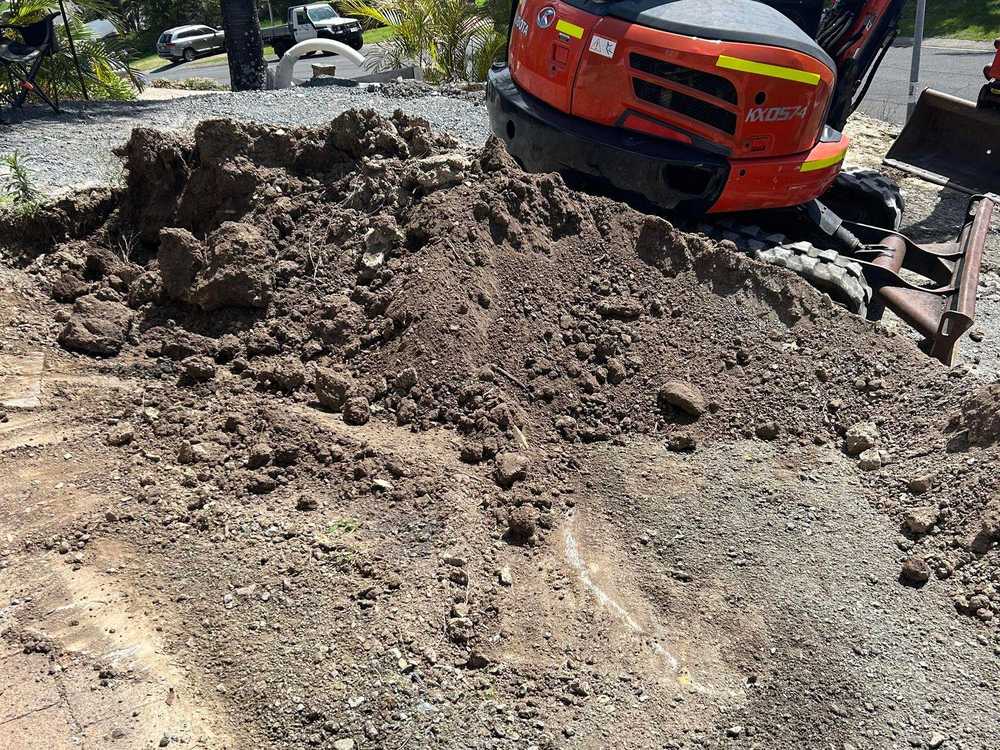
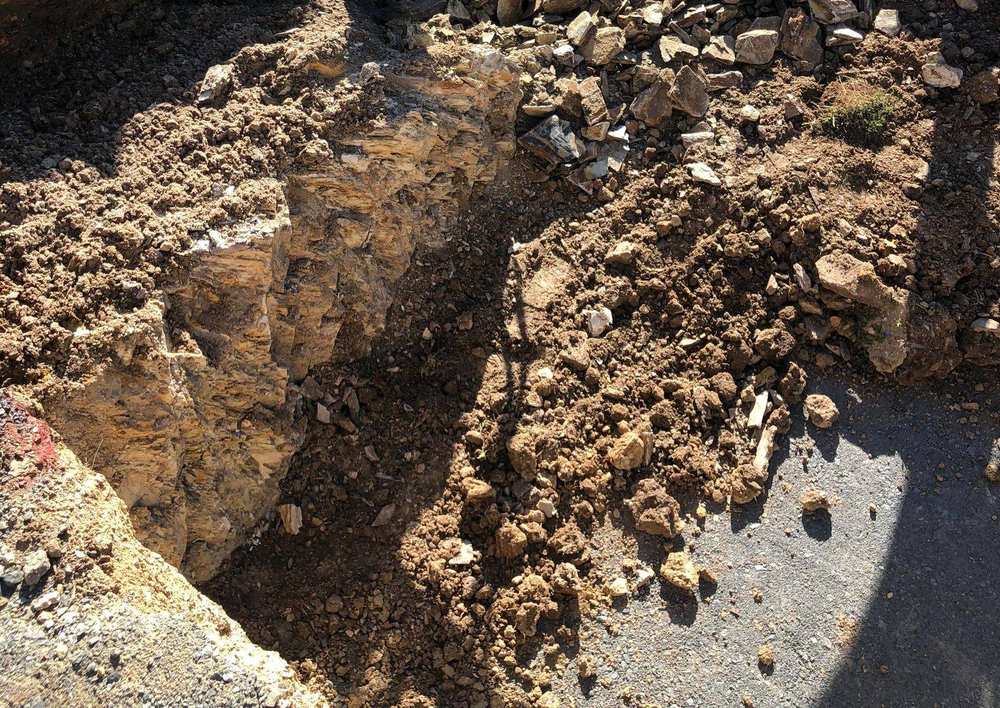
The ridges through Brisbane’s south are weathered rock under a skin of clay. A deep cut on a sloping block is far more likely to find it than a shallow strip on the flat. A ripper tyne sometimes pulls it apart; often it needs a hydraulic breaker, which is slow, and rock costs more to tip than clay. The photo below is what that looks like when it turns up: a shelf of rock that was not on anybody’s plan.
Retaining
Cut the high side and you have a vertical face of clay that will stand for a while and then will not. Fill the low side and you have a batter that needs holding up. Either way, retaining walls are a separate trade and a separate approval, and the cut has to be shaped so the wall can be built: a bench for the footing, a batter that stands up until the wall is in, and drainage behind it. Brisbane City Council’s filling and excavation page says you do not need planning approval to change the ground level by up to one vertical metre, unless the site is in a neighbourhood plan area or affected by an overlay, and that cut or fill of more than one vertical metre to construct a building needs building approval from a licensed building certifier. On a sloping block you are often over that metre on one side or the other, which is why the certifier and the engineer are involved before we are.
Access
Sloping blocks come with sloping driveways, retaining walls already in the way and a kerb that the tipper cannot back over. If the truck sits at the street and the skid steer ferries spoil up to it, you are paying for two machines and an operator who spends the day driving backwards and forwards. The easiest block to cut is one where the truck can stand next to the stockpile.
How do builders quote a site cut, and what does DES do differently?
Most builders carry a site works allowance in the contract, priced off the contour survey and the soil report before anyone has put a bucket in the ground. If the cut hits rock, the allowance runs out and the variation lands on you. That is not the builder being sneaky; nobody can see rock from the footpath. What matters is whether the allowance was honest to begin with and whether the earthworks contractor tells the truth when it runs out.
What we do differently is simple. The quote lists the cut, the spoil, the tipping and the fill as separate lines, with the assumptions written down: the depth we priced, the ground we expect and what happens per cubic metre if there is more rock or more unsuitable material than the survey showed. If the builder’s soil report classifies the site, we read it before we quote. Under the residential slabs and footings standard, AS 2870, the site is classified by how much the soil moves with moisture, and the slab is designed to suit; the Housing Industry Association’s summary of AS 2870 notes that the standard also covers construction on filled sites, which is why loose dumped fill under a pad is not an option. If the engineer wants compaction testing on the fill, a geotechnical tester does it and the certificate goes to the builder. We do not sign off our own fill.
Trees are the other thing to sort before the cut. A sloping block in the older suburbs usually has a few, some of them protected, and a tree that has to stay changes where the pad can go. The arborists at Dynamic Tree Solutions, our sister company, handle tree removal in Brisbane under the right approvals before we start, so the program runs through one office. Our post on site cut and fill for Brisbane builders covers how the two halves of a sloping block job balance out.
What should you send us to get a real number?
- The site plan with the pad level and the finished floor level.
- The contour survey, or at least the fall across the block.
- The soil report and site classification if the builder has one.
- Photos of the street frontage, the side access and anywhere the truck might stand.
- Whether retaining walls are planned and who is building them.
- What the neighbours hit when they built. It is a surprisingly good guide to rock.
With that we can quote a site cut on a sloping block in Carindale, Mount Gravatt or anywhere else across Brisbane’s south, Logan and Ipswich without guessing. If the cut runs into the bulk and detailed excavation for a townhouse site, the same crew prices that too.
Call 0424 168 352 or send the plans through the contact page and we will come back with the drivers listed.
Frequently asked questions
How much does a site cut cost in Brisbane?
It depends on the depth of the cut, how much spoil has to leave the block, whether there is rock, whether the cut needs retaining and how close a truck can get to the stockpile. A flat block is a strip and trim; a sloping block can mean many times the material for the same house. Send the site plan, the levels and the soil report and we quote it with the drivers listed.
Why is a site cut on a sloping block so much dearer than on a flat one?
Spoil. A pad cut 300 millimetres deep and the same pad cut 1.2 metres deep are the same floor plan but four times the dirt, and clay bulks up when it is dug. Trucks and tip fees scale with depth, and deeper cuts are more likely to find rock and need retaining.
Do I need council approval for a site cut?
Brisbane City Council says planning approval is not needed to change the ground level by up to one vertical metre unless the site is in a neighbourhood plan area or affected by an overlay, and cut or fill of more than one vertical metre to construct a building needs building approval from a licensed building certifier. Sloping blocks are often over the metre on one side. Logan and Ipswich have their own triggers.
How long does a site cut take?
One to three days of machine time for a typical house pad, longer on a steep block, in rock or where a lot of spoil has to be carted through tight access. Allow time before that for the survey, the engineer's levels, approvals and the Before You Dig enquiry.
Can you build the pad up with fill instead of cutting?
Yes, if the engineer's design allows it. Fill under a slab goes in layers and is compacted layer by layer, and AS 2870 has construction requirements for footings on filled sites. The engineer may want compaction testing by a geotechnical tester before the slab goes down.
What areas do you cover for site cuts?
Brisbane's south and south-west, Logan and Ipswich. Commercial and civil work further out is by quote.