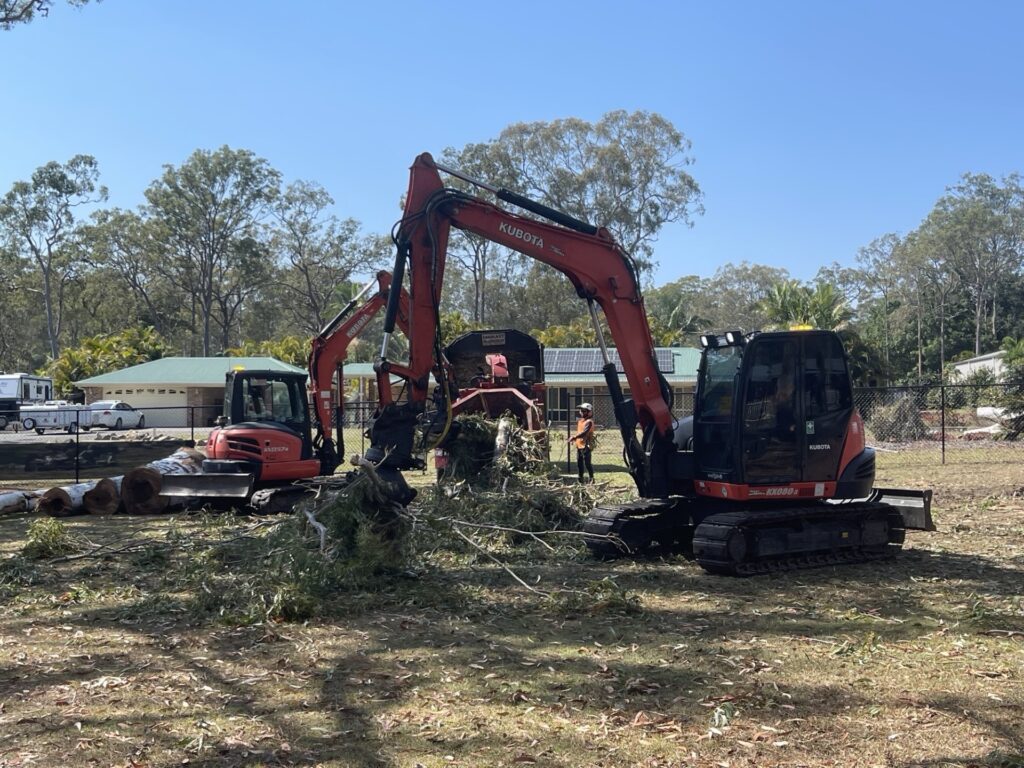
When developers break ground on a new South Brisbane subdivision or homeowners in Woolloongabba finally tackle that overgrown backyard, tree lopping Brisbane services become the critical first step in any successful project. Whether you’re preparing a commercial site in Rocklea for industrial development or clearing space for a new deck in Highgate Hill, understanding the differences between tree lopping, removal, and stump grinding ensures you select the right service, budget accurately, and comply with Brisbane City Council regulations.
Dynamic Earth Solutions is an indigenous-owned, Supply Nation registered civil and excavation contractor expanding throughout South Brisbane. While our core expertise lies in civil excavation, site preparation, and earthworks, we work closely with our sister company, Dynamic Tree Solutions, to deliver complete site clearing packages—from the first branch cut to the final compacted surface ready for construction.
This comprehensive guide covers everything Brisbane property owners, developers, and builders need to know about tree lopping and stump removal services. We’ll examine costs, council permits, safety requirements, and the crucial civil works that follow tree clearing—giving you the complete picture for your next project in South Brisbane and surrounding suburbs.
Tree Lopping vs Tree Removal vs Pruning: Understanding Your Options
The terms “tree lopping,” “tree removal,” and “pruning” are often used interchangeably, but they describe distinctly different arboricultural practices with varying costs, applications, and regulatory requirements. Selecting the wrong service wastes money and potentially harms valuable trees that could have been retained.
Tree Lopping Explained
Tree lopping involves the indiscriminate cutting of tree branches or stems between branch unions or internodal cuts. This practice reduces tree size quickly but often compromises tree health and structural integrity. Despite its limitations, tree lopping remains common in Brisbane for specific applications.
Legitimate uses for tree lopping include:
- Emergency response — Rapid size reduction after storm damage when precision pruning isn’t practical
- Pre-demolition clearing — When trees will be removed entirely anyway during site preparation
- Powerline clearance — Meeting Energex clearance requirements (typically 2-4 metres depending on voltage)
- Vegetation management — Reducing fire fuel loads in bushfire-prone areas like Tarragindi hillsides
For civil and commercial projects in areas like Forest Lake, Sunnybank, and Acacia Ridge, tree lopping typically occurs during the initial site clearing phase. Developers often require rapid vegetation reduction before detailed surveys, geotechnical investigations, or bulk and detailed excavations can commence.
Professional Tree Removal
Tree removal encompasses the complete extraction of a tree from a property, including the trunk, major limbs, and ideally the root system. Professional tree removal Brisbane services follow Australian Standard AS 4373-2007 (Pruning of amenity trees) protocols, even when the tree is destined for complete removal.
Tree removal becomes necessary when:
- Trees are dead, dying, or structurally compromised beyond remediation
- Root systems threaten building foundations, pipes, or retaining walls
- Trees fall within approved building footprints on development applications
- Species are classified as significant environmental weeds requiring eradication
- Trees pose unacceptable risk to persons or property (verified by arborist assessment)
Commercial developments in Coopers Plains, Archerfield, and Rocklea frequently require systematic tree removal across entire sites. The removal process typically progresses from canopy reduction to sectional trunk removal, finishing with stump grinding or excavation—each phase requiring specific equipment and expertise.
Pruning: The Preferred Alternative
Pruning represents the selective removal of plant parts (branches, buds, roots) to achieve defined objectives while maintaining tree health and structural integrity. Unlike lopping, pruning cuts occur at branch unions or nodes, allowing natural wound closure and reducing decay pathways.
Professional pruning types include:
| Pruning Type | Primary Purpose | Typical Cost Range (Brisbane) | Timeframe |
|---|---|---|---|
| Crown cleaning | Remove dead, dying, diseased branches | $350-$800 per tree | 2-4 hours |
| Crown thinning | Reduce density, improve light/air penetration | $450-$1,200 per tree | 3-6 hours |
| Crown raising | Remove lower branches for clearance | $300-$700 per tree | 1-3 hours |
| Crown reduction | Reduce overall size while maintaining form | $500-$1,500 per tree | 4-8 hours |
| Formative pruning | Develop strong structure in young trees | $150-$400 per tree | 1-2 hours |
For residential properties in suburbs like Coorparoo, Greenslopes, and Camp Hill, tree pruning experts can often address concerns about size, light blockage, or neighbour disputes without triggering council permit requirements. Pruning that removes less than 10% of the canopy generally falls outside Brisbane City Council’s vegetation protection regulations.
Why Hire Qualified Arborists for Tree Lopping Brisbane Projects
The difference between a qualified arborist and a general “tree guy with a chainsaw” often determines whether your project proceeds smoothly or descends into costly complications. For South Brisbane developments where timelines and budgets face constant pressure, engaging qualified professionals from the outset proves essential.
Arborist Qualifications in Queensland
Australia uses the Australian Qualifications Framework (AQF) to standardise arborist certifications. Different project types require different qualification levels:
- AQF Level 2 (Certificate II in Arboriculture) — Ground workers, basic chainsaw operation, chipper feeding
- AQF Level 3 (Certificate III in Arboriculture) — Climbing arborists, aerial rescue, tree removal operations
- AQF Level 5 (Diploma of Arboriculture) — Consulting arborists, report writing, expert witness testimony
When Brisbane City Council requires an arborist report for a development application, they typically mandate reports from AQF Level 5 consulting arborists. These specialists can prepare Arboricultural Impact Assessment reports that satisfy council requirements and withstand scrutiny during assessment.
Why Qualifications Matter for Commercial Projects
Civil and commercial projects in areas like Heathwood, Richlands, and Larapinta typically involve:
- Multiple stakeholder coordination — Principal contractors, developers, council officers, and environmental consultants all require professional documentation
- Compliance verification — Head contractors increasingly require current AQF certifications, SafeWork NSW equivalent cards, and company insurances before allowing subcontractors on site
- Report preparation — Tree protection plans per AS 4970-2009, tree retention values, and removal justifications require qualified assessment
- Risk documentation — Visual tree assessments and hazard reports protect all parties from liability
For residential homeowners in East Brisbane, Norman Park, or Fairfield, engaging AQF-certified arborists in Brisbane ensures work complies with council regulations, protects against insurance claim rejection, and maintains property value through proper tree care.
The Hidden Costs of Unqualified Operators
Choosing the cheapest quote from unqualified operators frequently results in:
- Council fines — Penalties for unpermitted tree removal in Brisbane range from $3,391 for individuals to $16,953 for corporations per offence
- Remediation orders — Council can require replacement plantings at ratios of 3:1 or higher, plus ongoing maintenance bonds
- Insurance claim rejection — Property damage caused during unpermitted or unqualified work typically falls outside standard policy coverage
- Project delays — Stop-work orders pending investigation can add weeks to construction schedules
- Reduced property value — Improper lopping creates hazardous regrowth requiring repeated intervention
Stump Removal Options — Grinding vs Excavation
After tree removal, property owners face a choice: leave the stump, grind it, or excavate it completely. Each option carries different cost implications, timeframes, and suitability for subsequent land uses. For construction projects across South Brisbane, this decision directly impacts foundation design, drainage planning, and site preparation costs.
Stump Grinding: The Standard Residential Solution
Stump grinding services use specialised machinery to mechanically chip stumps below ground level. Professional grinders reduce stumps to a depth of 200-400mm below surface grade, leaving a mixture of wood chips and soil that can be topped with turf or garden beds.
Stump grinding Brisbane suits residential applications where:
- No construction will occur directly over the former tree location
- Root systems don’t threaten nearby structures or services
- Rapid turnaround (most residential stumps ground in 30-60 minutes) is required
- Budget constraints preclude complete excavation
- Minimal site disturbance is preferred (no heavy machinery required)
Standard stump grinding equipment ranges from pedestrian machines (300mm wheel diameter) suitable for backyard access in Woolloongabba terraces, to track-mounted units (600mm+ wheel diameter) for large commercial stumps on Pallara development sites.
Stump Excavation: The Civil Construction Standard
For civil and commercial projects, stump grinding rarely suffices. Remaining root balls interfere with compaction, decomposing organic material creates settlement issues, and building codes prohibit organic matter within foundation zones. Complete stump excavation addresses these concerns.
Stump excavation involves:
- Root zone mapping — Identifying major structural roots and their extent (typically 2-3 times crown spread)
- Service location — Engaging Dial Before You Dig to identify underground services before excavation
- Mechanical extraction — Using excavators (typically 5-14 tonne for commercial stumps) to remove root ball and surrounding contaminated material
- Void remediation — Filling the excavation with approved fill material compacted to engineering specifications
- Surface preparation — Grading the area to integrate with surrounding site levels
At Dynamic Earth Solutions, our excavation services regularly include stump removal as part of broader building site preparation. This integrated approach eliminates coordination delays between tree removal contractors and civil contractors.
Comparison: Grinding vs Excavation
| Factor | Stump Grinding | Stump Excavation |
|---|---|---|
| Typical depth | 200-400mm below grade | Complete removal (often 1-3m) |
| Root removal | Surface roots only | Complete root ball |
| Equipment required | Stump grinder (pedestrian or tracked) | Excavator 5-30 tonne |
| Typical duration | 30 minutes – 2 hours per stump | 1-4 hours per stump |
| Site disturbance | Minimal (600mm radius typical) | Significant (2-5m radius typical) |
| Suitable for building over | No (without additional excavation) | Yes (with proper compaction) |
| Residential cost range | $150-$500 per stump | $400-$1,500 per stump |
| Commercial cost range | $200-$800 per stump | $800-$3,500 per stump |
| Fill material required | Wood chip/soil mix only | Certified clean fill |
| Compaction testing | Not required | Required per AS 3798 |
Chemical Stump Treatment
A third option—chemical stump treatment—accelerates natural decomposition over 6-12 months. This approach suits situations where immediate removal isn’t required, such as acreage properties or areas where stumps will eventually be covered by landscaping. However, chemical treatment has no application in construction contexts where immediate site preparation is required.
Brisbane City Council Tree Permit Process
Understanding Brisbane City Council tree regulations before commencing any tree work prevents costly delays, fines, and remediation requirements. The permit process varies significantly between residential property maintenance and commercial development projects.
When Permits Are Required
Brisbane City Council’s Natural Assets Local Law 2003 protects significant vegetation across the city. Trees meeting any of the following criteria require council approval before removal or significant pruning:
- Trunk diameter at 1.3m height — 40cm or greater (measured above ground level)
- Total height — 4 metres or more
- Listed species — Any species on council’s significant species list regardless of size
- Overlay mapping — Trees within mapped waterway corridors, habitat areas, or character precincts
- Development approval conditions — Trees subject to retention conditions on existing approvals
For properties in established South Brisbane suburbs like Dutton Park, Annerley, and Yeronga, most mature trees meet at least one threshold. Newer subdivisions in Pallara or Heathwood may have fewer significant trees but often fall within environmental overlay areas.
Residential Permit Process
Residential property owners seeking to remove protected trees must:
- Confirm protection status — Use council’s online mapping tool or request a site inspection
- Document justification — Photograph damage, structural concerns, or other grounds for removal
- Submit application — Online through council’s planning and development portal
- Provide arborist report — If required, engage a qualified arborist for formal assessment
- Await determination — Standard processing time 10-20 business days
- Comply with conditions — Replacement plantings, timing restrictions, or method specifications
Application fees for residential tree removal currently range from $200-$400 depending on the number of trees and application complexity. Engaging consulting arborist reports adds $300-$800 but significantly improves approval likelihood for marginal applications.
Development Application Process
Commercial and development projects face more rigorous vegetation assessment requirements. The development application (DA) process integrates tree assessment through:
- Pre-lodgement consultation — Discuss vegetation constraints before finalising site plans
- Arboricultural Impact Assessment — Comprehensive report detailing all trees, proposed impacts, and mitigation measures
- Tree Protection Management Plan — AS 4970-compliant specifications for protecting retained trees during construction
- Offset calculations — Where removal is approved, offset requirements apply (often replacement ratios of 3:1 to 10:1)
- Compliance inspections — Council officers verify tree protection measures during construction
For large-scale land clearing Brisbane projects, vegetation assessments may require ecological surveys identifying fauna habitat, flora significance, and connectivity values. Projects in mapped Koala habitat areas face additional assessment requirements through Queensland’s Planning Regulation 2017.
Exemptions from Permit Requirements
Certain situations exempt tree work from council approval:
- Immediate danger — Trees posing imminent risk to life or property (document thoroughly before removal)
- Declared pest species — Species listed under the Biosecurity Act 2014 (e.g., Chinese Celtis, Camphor Laurel in some circumstances)
- Within 3 metres of a habitable building — Some vegetation near existing structures (confirm with council—conditions apply)
- Maintenance pruning — Removing less than 10% of canopy using proper techniques
- Energex clearances — Works required for powerline safety (coordinated through Energex)
When uncertainty exists, contact council’s vegetation management team before proceeding. The cost of a pre-application consultation is negligible compared to enforcement action consequences.
Cost of Tree Lopping in Brisbane
Understanding tree lopping cost Brisbane helps property owners budget accurately and evaluate quotes effectively. Pricing varies significantly based on tree characteristics, site access, and project complexity.
Residential Tree Lopping Costs
For residential properties in suburbs like Stones Corner, Holland Park, and Carindale, typical tree lopping and removal costs include:
Small trees (under 5 metres height):
- Basic removal and disposal: $300-$700
- With stump grinding: $450-$950
- Timeframe: 1-3 hours on site
Medium trees (5-10 metres height):
- Basic removal and disposal: $700-$1,500
- With stump grinding: $900-$1,800
- Timeframe: 3-6 hours on site
Large trees (10-20 metres height):
- Basic removal and disposal: $1,500-$3,500
- With stump grinding: $1,800-$4,000
- Timeframe: 6-12 hours on site (may require multiple days)
Very large/complex trees (over 20 metres or difficult access):
- Basic removal and disposal: $3,500-$8,000+
- With stump grinding: $4,000-$9,000+
- Timeframe: 1-3 days on site
The tree removal cost Brisbane market remains competitive, but significantly below-market quotes often indicate unqualified operators, inadequate insurance, or corner-cutting on safety and disposal. Always verify qualifications, insurances, and council permit compliance before engaging contractors.
Commercial and Civil Tree Lopping Costs
Commercial project pricing differs from residential due to:
- Volume efficiencies — Multiple trees on one site reduce per-tree mobilisation costs
- Access advantages — Unrestricted site access allows larger equipment, faster completion
- Documentation requirements — Commercial contracts require detailed JSAs, SWMS, and compliance records
- Insurance levels — Commercial sites typically require $10-20 million public liability (vs $5-10 million residential)
- Coordination complexity — Working around other trades, staging requirements, and principal contractor systems
Civil projects in Sunnybank, Acacia Ridge, and Rocklea industrial areas typically price tree clearing on a per-hectare or lump-sum basis rather than per-tree rates. Costs range from $5,000-$15,000 per hectare for light vegetation to $30,000-$80,000 per hectare for dense bushland requiring forestry mulching or systematic removal.
Factors Affecting Tree Lopping Costs
When comparing quotes for professional tree lopping services, consider these cost drivers:
- Tree species — Hardwoods take longer to cut; some species (e.g., Hoop Pine) have heritage value affecting approval
- Health condition — Dead trees may be structurally unpredictable; diseased trees require specific disposal
- Access constraints — Narrow side gates, overhead powerlines, or swimming pools significantly increase complexity
- Proximity to structures — Trees within falling distance of buildings require sectional removal (slower, more expensive)
- Traffic management — Street trees may require council permits and traffic control (add $500-$2,000)
- Disposal method — On-site mulching vs removal affects pricing; tip fees vary by waste type
- Time of year — Storm season demand spikes increase wait times and potentially pricing
Cost of Stump Removal in Brisbane
The stump removal cost depends primarily on stump diameter, root complexity, access, and chosen removal method. Brisbane’s clay-dominant soils and subtropical vegetation create specific challenges that affect pricing.
Stump Grinding Cost Brisbane
Stump grinding Brisbane pricing typically follows per-stump or diameter-based rates:
- Small stumps (under 30cm diameter): $100-$200 per stump
- Medium stumps (30-60cm diameter): $200-$400 per stump
- Large stumps (60-100cm diameter): $400-$700 per stump
- Very large stumps (over 100cm diameter): $700-$1,200+ per stump
Most operators offer volume discounts for multiple stumps—typically 10-20% reduction for three or more stumps on the same property. Minimum call-out charges ($150-$250) apply regardless of stump size.
Stump Excavation Costs
Complete stump excavation—removing the entire root ball and surrounding contaminated material—costs significantly more but enables immediate construction:
- Small stumps (under 30cm): $350-$600 per stump
- Medium stumps (30-60cm): $600-$1,200 per stump
- Large stumps (60-100cm): $1,200-$2,500 per stump
- Very large stumps (over 100cm): $2,500-$5,000+ per stump
These rates include excavation, loading, and removal of organic material but typically exclude certified fill replacement and compaction testing. For commercial projects, add 30-50% for complete remediation including imported fill and compaction certification per AS 3798.
Combined Tree Lopping and Stump Removal Pricing
Tree lopping and stump removal packages offer cost efficiencies by combining operations. Typical residential package pricing:
- Small tree + stump grinding: $450-$900 total
- Medium tree + stump grinding: $900-$2,000 total
- Large tree + stump grinding: $2,000-$4,500 total
- Very large tree + stump excavation: $4,500-$12,000+ total
For homeowners in Moorooka, Yeerongpilly, and Tarragindi, requesting combined quotes from expert tree lopping Brisbane operators ensures competitive pricing and single-contractor accountability.
Civil Excavation After Stump Removal
For construction projects, tree and stump removal represents just the first phase of site preparation. The civil works that follow determine whether the site meets engineering specifications for safe, durable construction. This integration of arboricultural and civil services is where Dynamic Earth Solutions delivers value beyond standalone tree removal contractors.
Site Assessment and Planning
Following tree removal, civil contractors must assess:
- Soil conditions — Root decomposition alters soil structure; testing per AS 1289 verifies bearing capacity
- Drainage impacts — Removed trees no longer transpire water; drainage design must accommodate changed hydrology
- Level variations — Stump excavations create depressions requiring fill and compaction
- Underground services — Tree roots often grow around pipes and cables; removal may expose or damage services
- Contamination — Organic material within fill zones must be removed to prevent settlement
Our site levelling and grading services address these issues systematically, creating construction-ready surfaces that meet engineering specifications.
Fill and Compaction Requirements
Australian Standard AS 3798 (Guidelines on earthworks for commercial and residential developments) specifies fill and compaction requirements for construction sites. Key parameters include:
- Fill material — Clean fill, free of organic material, oversized rocks, and contamination
- Maximum layer thickness — Typically 150-300mm loose thickness depending on compaction equipment
- Compaction standard — Minimum 95% Standard Compaction for residential; 98% for commercial loads
- Testing frequency — One test per 500m² or major fill zone, plus random verification
- Documentation — Compaction certificates signed by registered engineer
For properties in South Brisbane where the water table sits relatively high, fill material selection becomes critical. Our team works with geotechnical engineers to specify appropriate materials for each site’s conditions.
Integration with Broader Civil Works
Stump removal often occurs alongside other site preparation activities:
- Tree clearing for construction — Systematic vegetation removal across development footprints
- Bulk excavation — Removing unsuitable material to reach competent bearing strata
- Footings and trenches — Preparing foundation and service trenches
- Civil drainage installation — Installing stormwater systems per Brisbane City Council stormwater drainage requirements
- Concrete and slab preparation — Creating precisely graded bases for structural concrete
Coordinating these activities through a single civil contractor eliminates interface issues, reduces mobilisation costs, and maintains schedule momentum.
Insurance and Safety for Tree Lopping Brisbane Projects
Tree work ranks among Australia’s most hazardous occupations. WorkSafe Queensland excavation guidelines and associated regulations establish minimum safety requirements that protect workers and property owners alike.
Insurance Requirements
Reputable Brisbane tree services providers carry:
- Public liability insurance — Minimum $10 million for residential; $20 million for commercial sites
- Workers’ compensation — Covering all employees for workplace injuries
- Professional indemnity — For consulting arborists providing advice and reports
- Equipment insurance — Protecting chainsaws, chippers, and vehicles from damage
Before engaging any tree contractor, request current certificates of currency. Note that many insurance policies exclude unlicensed work, meaning unqualified operators may carry insurance that won’t respond to claims arising from their activities.
Safety Documentation
Commercial projects require comprehensive safety documentation:
- Safe Work Method Statement (SWMS) — Specific to tree work hazards including chainsaw use, working at height, and chipper operation
- Job Safety Analysis (JSA) — Site-specific risk assessment completed before work commences
- Exclusion zones — Minimum 2x tree height for felling operations; 15 metres from chipper feed
- Emergency procedures — Aerial rescue capability, first aid provisions, and emergency contacts
- Competency records — Current qualifications for all personnel undertaking regulated tasks
At Dynamic Earth Solutions, our safety and compliance standards align with principal contractor requirements across South East Queensland. This ensures seamless integration when our civil works follow tree removal operations.
Homeowner Safety Considerations
Residential property owners should:
- Clear the work area of vehicles, outdoor furniture, and pets before crews arrive
- Identify any underground services (water, gas, electrical, telecommunications) that may fall within the work zone
- Advise contractors of any neighbourhood sensitivities (shift workers, elderly residents, etc.)
- Keep children and other household members inside during active tree work
- Verify that quotes include all disposal costs and council permit fees where applicable
For properties in densely settled suburbs like West End, Kangaroo Point, and South Brisbane proper, careful planning around narrow access, heritage overlays, and body corporate requirements prevents complications during execution.
South Brisbane Tree Services Coverage
Dynamic Earth Solutions and our sister company, Dynamic Tree Solutions, provide integrated tree lopping South Brisbane and civil excavation services across the greater South Brisbane region. Our expanding presence in this growth corridor positions us to serve both residential and commercial clients efficiently.
Residential Service Areas
Arborist Brisbane services through Dynamic Tree Solutions cover:
- Inner South Brisbane — South Brisbane, West End, Highgate Hill, Dutton Park, Woolloongabba
- Eastern suburbs — East Brisbane, Kangaroo Point, Norman Park, Coorparoo, Greenslopes
- Southern suburbs — Stones Corner, Annerley, Fairfield, Yeronga, Yeerongpilly
- Outer southern suburbs — Tarragindi, Moorooka, Holland Park, Camp Hill, Carindale
Residential clients benefit from our sister company’s full commercial tree services capabilities scaled for residential applications. Whether you need a single tree assessed, storm damage cleared, or a complete backyard renovation prepared, the same qualified arborists and professional equipment deliver consistent results.
Commercial and Civil Focus Areas
Commercial developments concentrate in specific South Brisbane corridors where our civil capabilities complement tree services:
- Industrial precincts — Rocklea, Archerfield, Acacia Ridge, Coopers Plains
- Growth corridors — Forest Lake, Richlands, Heathwood, Pallara, Larapinta
- Mixed-use developments — Sunnybank, Moorooka, Yeronga transit-oriented developments
These areas see continuous development activity requiring coordinated vegetation clearing and civil preparation. Our ability to deliver tree removal through Dynamic Tree Solutions followed immediately by excavation, site levelling, and drainage installation through Dynamic Earth Solutions eliminates scheduling gaps and interface risks.
Emergency Response Coverage
South East Queensland’s storm season generates significant emergency tree work demand. Our 24/7 emergency tree response service operates across all South Brisbane suburbs, providing:
- Rapid response to storm-damaged trees blocking roads or threatening structures
- Temporary make-safe measures pending permanent remediation
- Dangerous tree removal specialists for complex fallen tree extractions
- Coordination with Queensland State Emergency Service during declared events
- Hazardous tree clearing specialists for multi-property damage situations
When emergency tree work transitions to civil recovery—clearing access roads, restoring drainage, or stabilising damaged sites—our emergency civil works Queensland capability ensures seamless handover. The Queensland Reconstruction Authority often coordinates larger recovery efforts, and our teams maintain readiness to support these operations.
Frequently Asked Questions
How much does tree lopping cost in Brisbane?
Tree lopping costs in Brisbane range from $300-$700 for small trees under 5 metres to $3,500-$8,000+ for large or complex trees over 20 metres. Medium trees (5-10 metres) typically cost $700-$1,500 for removal and disposal. These prices vary based on species, access conditions, proximity to structures, and disposal requirements. Adding stump grinding increases costs by $150-$500 for most residential stumps. Always obtain multiple quotes from qualified operators carrying appropriate insurance—the cheapest quote often indicates compromised safety practices or unqualified personnel.
Do I need a permit to remove a tree in Brisbane?
Brisbane City Council requires permits for removing trees that exceed 4 metres in height, have trunk diameters of 40cm or more at 1.3 metres above ground, are listed significant species, or fall within mapped environmental overlays. Exemptions exist for immediate safety hazards, declared pest species, and maintenance pruning removing less than 10% of canopy. To check your tree’s protection status, use council’s online mapping tool or contact their vegetation management team. Unpermitted removal of protected trees carries fines up to $16,953 per offence for corporations and may require costly remediation plantings.
What is the difference between stump grinding and stump removal?
Stump grinding uses a mechanical grinder to chip the stump 200-400mm below ground level, leaving the root system in place. This suits residential landscaping where no construction will occur. Stump removal (excavation) involves digging out the entire root ball, typically extending 1-3 metres deep depending on tree size. Complete removal is required for construction sites because remaining organic material causes settlement and prevents achieving required compaction levels. Grinding costs $150-$700 per stump; complete excavation costs $400-$3,500+ depending on size and access conditions.
How long does stump removal take?
Stump grinding typically takes 30 minutes to 2 hours per stump depending on size and root configuration. Complete stump excavation requires 1-4 hours per stump for the digging operation, plus additional time for fill replacement and compaction if preparing for construction. For residential properties, most grinding jobs complete within half a day including setup. Commercial projects with multiple stumps benefit from efficiency gains—a 20-stump site might require 2-3 days total rather than the 10-15 days implied by individual per-stump timeframes.
Can I build over a ground stump?
Building directly over a ground stump is not recommended and may violate building codes. Ground stumps typically leave 200-400mm of stump plus the entire root system underground. As this organic material decomposes (a process taking 5-15 years), it creates voids causing differential settlement that cracks slabs and damages structures. For construction applications, complete stump excavation followed by certified fill and compaction testing per AS 3798 is required. Any reputable builder or building certifier will require evidence of proper stump removal before approving construction over former tree locations.
What qualifications should a tree lopper have?
At minimum, climbing tree workers should hold AQF Level 3 Certificate III in Arboriculture, qualifying them for aerial chainsaw work and rescue procedures. Ground workers require AQF Level 2 certification. For arborist reports required by Brisbane City Council, engage practitioners holding AQF Level 5 Diploma of Arboriculture—these consulting arborists can prepare development application documentation and provide expert opinions. Additionally, verify current SafeWork Queensland high-risk work licences for chainsaws and verify public liability insurance (minimum $10 million for residential work, $20 million for commercial sites).
How much does an arborist report cost in Brisbane?
Basic arborist reports for single-tree residential assessments cost $300-$500. More comprehensive Arboricultural Impact Assessments required for development applications range from $600-$2,500 depending on site size and tree numbers. Tree Protection Management Plans per AS 4970 add $500-$1,500 to project documentation costs. For commercial developments, budget $2,000-$10,000 for complete arboricultural documentation including impact assessments, protection plans, and offset calculations. Engaging qualified consulting arborists early prevents costly redesigns when unidentified significant trees are discovered during development application assessment.
What happens to the wood after tree removal?
Tree removal contractors typically chip branches and smaller material on-site using wood chippers, producing mulch that can be left on-site for garden use or removed. Trunk sections may be cut into firewood lengths for the property owner, removed for firewood resale, or taken to timber recycling facilities. Some high-value species (e.g., mature Silky Oak or Red Cedar) attract timber merchants willing to pay for millable logs. Most residential quotes include disposal in the price; verify this explicitly and confirm tip fee assumptions if you want material removed from site rather than mulched on-site.
Are tree roots included in stump grinding?
Standard stump grinding removes the stump and surface roots within approximately 300-600mm radius of the trunk, grinding to 200-400mm below grade. Major lateral roots extending beyond this zone remain in place underground. For landscaping purposes, these roots cause no problems—they decompose over 5-10 years and grass or gardens grow over the area. However, for construction applications or where root systems are damaging infrastructure (retaining walls, paths, pipes), complete root excavation is required rather than surface grinding. Discuss your intended use with contractors when obtaining quotes to ensure appropriate removal methods.
Can trees be removed during nesting season?
Tree removal during breeding season (typically August-February for most Brisbane bird species) requires additional assessment under Queensland’s Nature Conservation Act. If active nests are identified, removal must wait until young have fledged—typically 2-6 weeks depending on species. For threatened species (e.g., Powerful Owl, Grey-headed Flying-fox camps), additional approvals and offsets may apply. Development applications typically include fauna assessments addressing nesting habitat. For residential removals, qualified arborists inspect trees before work commences and advise on any constraints. Proceeding with removal despite active nests risks wildlife offences carrying penalties exceeding $20,000.
How deep do stump grinders go?
Professional stump grinders can reach depths of 200-450mm below ground level depending on machine specifications and operator settings. Standard residential grinding typically achieves 200-300mm depth—sufficient for laying turf or garden beds. Deeper grinding (400mm+) may be specified where paths, driveways, or shallow garden beds are planned. Note that depth refers to below original ground level, not below the stump surface. A 500mm above-ground stump ground to 300mm below grade requires removal of 800mm total material. Depth requirements should be discussed during quoting to ensure adequate specifications and pricing.
What is an Arboricultural Impact Assessment?
An Arboricultural Impact Assessment (AIA) is a formal report prepared by qualified consulting arborists to satisfy Brisbane City Council development application requirements. The report inventories all trees on and adjacent to development sites, assesses their significance and retention value, identifies proposed impacts from construction activities, and recommends mitigation or offset measures. AIAs reference Australian Standard AS 4970 (Protection of trees on development sites) and inform Tree Protection Management Plans specifying exclusion zones, construction methods, and monitoring requirements. Council assessment officers use AIAs to impose conditions on development approvals and calculate offset requirements where tree removal is permitted.
Do you offer stump removal for commercial sites?
Yes—commercial stump removal is a core capability for Dynamic Earth Solutions. Unlike residential grinding that leaves root systems in place, commercial sites typically require complete excavation removing all organic material within building footprints. We integrate stump excavation with broader site preparation works including bulk excavation, fill importation, compaction to AS 3798 specifications, and certification testing. This integrated approach eliminates coordination delays between separate tree and civil contractors. For commercial inquiries across South Brisbane industrial areas including Rocklea, Archerfield, and Coopers Plains, contact our team for project-specific quotations.
“The integration of tree removal and civil preparation through our partnership with Dynamic Tree Solutions means developers get single-point accountability from the first tree cut to the final compaction certificate. That coordination eliminates the finger-pointing and delays that plague multi-contractor approaches.”
Get Started with Your South Brisbane Tree and Civil Project
Whether you’re a developer preparing a Forest Lake subdivision, a builder starting site works in Sunnybank, or a homeowner in Yeronga needing that problem tree addressed, professional tree lopping and civil services ensure your project proceeds safely, compliantly, and on schedule.
Dynamic Earth Solutions is proudly indigenous-owned and Supply Nation registered, bringing cultural responsibility and professional excellence to every project. To learn more about our team and our indigenous-owned story, explore our website or browse our complete civil services list.
For tree lopping, stump grinding, and arborist services, our sister company Dynamic Tree Solutions provides qualified arborist Brisbane professionals across all South Brisbane suburbs. Their team handles everything from single-tree residential removals to large-scale land clearing Brisbane operations, with full council permit support and consulting arborist reports available.
Ready to discuss your project? Contact our team for obligation-free quotes on civil excavation, site preparation, and integrated tree-to-construction services. For urgent tree matters including storm damage or hazardous trees, Dynamic Tree Solutions’ 24/7 emergency tree response service is available around the clock.
Visit our blog for more insights on civil construction, site preparation, and working with indigenous contractors. For answers to common questions, our frequently asked questions page covers project planning, pricing, and process details.