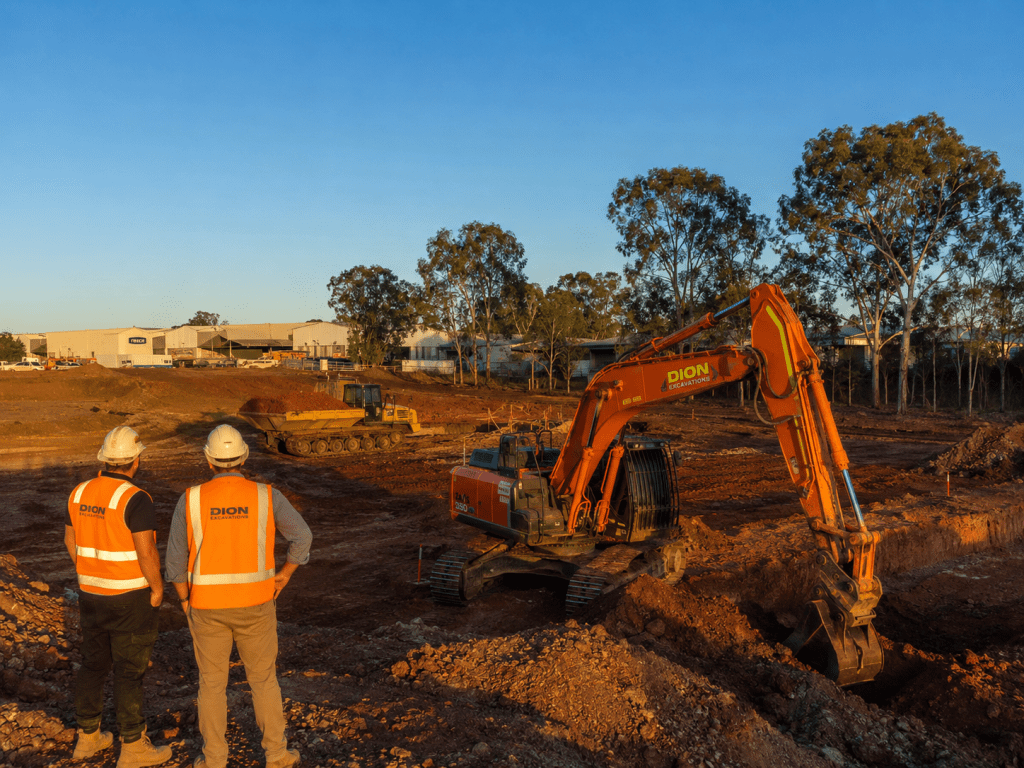
South East Brisbane’s industrial corridor represents one of Queensland’s most active commercial development zones, with established estates in Rocklea, Acacia Ridge, and Archerfield undergoing continuous expansion and renewal. For industrial developers, warehouse operators, and commercial property owners navigating this competitive market, securing a commercial excavation south east brisbane specialist who understands both the technical demands and regulatory landscape is essential to project success.
Dynamic Earth Solutions brings indigenous-owned expertise and Supply Nation registration to commercial excavation projects throughout South East Brisbane’s industrial heartland. Our expansion from the Gold Coast into this region responds to growing demand from developers who require contractors capable of handling complex industrial earthworks while meeting tight construction schedules and stringent compliance requirements.
This comprehensive guide examines every aspect of commercial and industrial excavation in South East Brisbane—from suburb-specific considerations and council compliance through to equipment capabilities, cost structures, and integration with broader construction programs. Whether you’re developing a new distribution centre in Heathwood or upgrading hardstand facilities at an existing Coopers Plains warehouse, the following information provides the technical foundation for informed decision-making.
Commercial Excavation in South East Brisbane — The Industrial Estate Market
South East Brisbane’s industrial property market demonstrates remarkable resilience and growth, driven by e-commerce logistics demands, manufacturing reshoring trends, and Brisbane’s strategic position as a national distribution hub. The region bounded by the Ipswich Motorway to the north and extending toward Logan presents a concentrated industrial zone where commercial excavation requirements vary significantly based on site history, intended use, and underlying geology.
Understanding these market dynamics is crucial for developers engaging excavation contractors. Unlike residential projects where scope remains relatively predictable, industrial excavation in this region involves highly variable conditions that impact methodology, equipment selection, and ultimately project costs.
Current Market Conditions Affecting Commercial Excavation
Several factors currently influence commercial excavation pricing and scheduling in South East Brisbane:
- Soil variability — Sites range from alluvial clay deposits near Oxley Creek through to reactive black soils in Acacia Ridge, requiring different compaction approaches
- Contamination prevalence — Many brownfield sites in established industrial areas carry historical contamination requiring remediation before or during excavation
- Infrastructure density — Underground services in mature industrial estates create excavation constraints requiring Dial Before You Dig verification and careful methodology
- Traffic management complexity — Heavy vehicle access to sites during excavation phases requires coordination with council transport authorities
- Flooding history — Post-2011 and 2022 flood events have increased council scrutiny of stormwater management in excavation planning
The Brisbane City Council planning and development framework establishes clear requirements for industrial zone development, with excavation works typically requiring development approval where bulk earthworks exceed specified thresholds or where filling may affect neighbouring properties.
Industrial vs Commercial Excavation Requirements
Distinguishing between industrial and commercial excavation helps clarify project scope and contractor capability requirements:
| Factor | Industrial Excavation | Commercial Excavation |
|---|---|---|
| Typical floor loading | 15-50 kPa (heavy manufacturing, warehousing) | 5-15 kPa (office, retail) |
| Pavement design | Heavy duty (container handling, forklifts) | Standard vehicle traffic |
| Subgrade preparation | CBR 15-30% typical specification | CBR 5-15% typical specification |
| Typical cut depth | 600mm-2000mm for pad preparation | 300mm-800mm typical |
| Compaction standard | 98% Standard Proctor density | 95% Standard Proctor density |
| Testing frequency | Every 500m³ or lift layer | Every 1000m³ typical |
Our bulk and detailed excavations capability covers both industrial and commercial specifications, with equipment and methodology adapted to project-specific requirements verified through geotechnical assessment.
Industrial Suburbs We Specialise In
South East Brisbane’s industrial corridor encompasses distinct precincts, each presenting unique excavation considerations based on development history, topography, and soil conditions. Understanding these suburb-specific factors enables accurate project planning and realistic cost estimation.
Rocklea Industrial Precinct
As one of Brisbane’s oldest industrial areas, Rocklea presents both opportunities and challenges for excavation contractors. The suburb’s proximity to the Brisbane Markets and established transport links makes it attractive for cold storage, food processing, and distribution facilities. However, civil works Rocklea projects frequently encounter:
- Alluvial soils from Oxley Creek requiring extensive subgrade treatment
- Historical contamination from former manufacturing operations
- High groundwater tables affecting deep excavation methodology
- Dense underground service networks in established estates
Our commercial earthworks rocklea experience includes warehouse pad preparation, drainage upgrades for stormwater compliance, and brownfield site remediation. Typical cut-to-fill ratios in Rocklea average 1.2:1, with imported structural fill often required to achieve specified subgrade standards.
Acacia Ridge Industrial Hub
Acacia Ridge anchors South East Brisbane’s logistics sector, with the intermodal terminal driving demand for warehouse and distribution facilities. Excavation Acacia Ridge projects typically involve larger site footprints suited to modern logistics operations, with specific requirements including:
- Heavy-duty hardstand construction for container handling
- Large-format warehouse pad preparation (10,000m² to 50,000m² typical)
- Stormwater detention basin construction for increased impervious area
- Truck queuing and manoeuvring area earthworks
The suburb’s reactive clay soils require careful moisture management during earthworks, with AS 3798 earthworks guidelines specifying compaction procedures for expansive soils. Our industrial excavation acacia ridge methodology incorporates lime stabilisation where geotechnical assessments indicate problematic soil reactivity.
Archerfield Airport Industrial Estate
The Archerfield precinct offers unique industrial land opportunities, though aviation-related restrictions and specific excavation Archerfield requirements apply. Projects near the aerodrome require coordination with aviation authorities regarding crane heights, equipment positioning, and excavation depths that might affect runway approaches.
Our commercial excavation archerfield work encompasses aerospace manufacturing support facilities, aviation maintenance hangars, and general industrial development. The area’s well-drained sandy soils generally provide favourable excavation conditions compared to clay-dominant suburbs.
Emerging Industrial Growth Zones
The western corridor including Pallara, Heathwood, and Larapinta represents South East Brisbane’s industrial expansion frontier. These suburbs offer greenfield development opportunities with fewer brownfield complications, though native vegetation clearing and stormwater management for newly developed sites require specialist approaches.
As a civil contractor Pallara with demonstrated capability, we work extensively in these growth zones where larger site areas and less constrained access allow efficient bulk excavation operations. Similarly, our civil contractor Heathwood and civil contractor Larapinta services support developers capitalising on this expansion corridor.
Established Industrial Suburbs
The inner industrial ring including Coopers Plains, Richlands, Durack, and Inala presents different excavation dynamics. Sites here typically involve brownfield redevelopment, facility upgrades, or intensification of existing industrial uses. Our specialist services include:
- Excavation Coopers Plains — Warehouse conversions and facility upgrades in established estates
- Excavation Richlands — Manufacturing facility earthworks and hardstand reconstruction
- Civil contractor Durack — Industrial strata title projects and body corporate works
- Civil contractor Inala — Light industrial and commercial development excavation
Warehouse and Distribution Centre Site Preparation
Modern warehouse development in South East Brisbane demands precise site preparation that accommodates high-bay racking systems, automated materials handling, and intensive truck movements. As an experienced industrial civil contractor brisbane, we understand that inadequate site preparation directly impacts operational efficiency and long-term maintenance costs.
Floor Slab Subgrade Requirements
Warehouse floor slabs represent significant capital investment, with ground-bearing slabs requiring uniform subgrade support to prevent differential settlement. Our concrete and slab preparation methodology for distribution centres follows established engineering principles:
- Topsoil stripping — Remove organic material to minimum 200mm depth or until competent subgrade exposed
- Cut to design level — Achieve design RL with ±20mm tolerance across pad footprint
- Proof rolling — Identify soft spots using loaded tandem roller before fill placement
- Subgrade treatment — Lime or cement stabilisation where CBR falls below design specification
- Fill placement — Controlled lift placement (150mm maximum compacted thickness)
- Compaction testing — Density testing per AS 1289 soil testing methods
- Fine trimming — Final surface preparation to ±10mm tolerance for slab construction
The warehouse site preparation brisbane market increasingly demands higher subgrade specifications as automated systems require flatter, more uniform floors. Where traditional tolerances accepted FL/200 flatness, modern distribution centres often specify FL/100 or better, requiring correspondingly precise subgrade preparation.
Typical Warehouse Site Preparation Costs
| Site Condition | Preparation Cost (per m²) | Typical Timeline | Key Variables |
|---|---|---|---|
| Greenfield (minimal cut/fill) | $25-45 | 4-8 weeks | Vegetation clearing, topsoil depth |
| Brownfield (existing slab removal) | $45-75 | 6-12 weeks | Demolition extent, contamination |
| Challenging soils (reactive clay) | $55-90 | 8-14 weeks | Stabilisation requirements |
| High groundwater sites | $65-110 | 10-16 weeks | Dewatering, import fill volume |
| Contaminated land | $85-150+ | 12-24 weeks | Remediation strategy, disposal |
These indicative figures help project budgeting but require geotechnical assessment for accurate pricing. Our contact our team process includes preliminary site assessment to refine cost estimates before formal quotation.
Dock Leveller and Loading Bay Excavation
Distribution centre functionality depends on efficient truck interface, typically requiring recessed dock positions and drive-in ramps. Dock excavation involves:
- Pit excavation — Typically 1200mm depth below finished floor for dock leveller installation
- Ramp grading — 1:12 to 1:15 gradient for semi-trailer access
- Drainage provision — Sump installation and connection to stormwater system
- Edge preparation — Accurate formwork platforms for dock wall construction
Our civil drainage installation capability integrates with dock excavation, ensuring stormwater management addresses both dock yard runoff and building drainage requirements per Brisbane City Council stormwater drainage specifications.
Hardstand, Loading Bay and Truck Yard Excavation
Industrial hardstand represents the operational interface between buildings and transport networks. Unlike building pads where structural engineers specify subgrade requirements, hardstand design often falls to pavement engineers, creating different excavation specifications and testing protocols.
Heavy-Duty Hardstand Classification
Pavement design for industrial hardstand considers axle loads, traffic volume, and expected pavement life. Our bulk excavation industrial brisbane methodology adapts to specified pavement classifications:
| Hardstand Type | Typical Design Load | Subgrade CBR Required | Pavement Thickness |
|---|---|---|---|
| General truck access | Standard axle (8.2t) | CBR 10+ | 250-350mm |
| Heavy vehicle queuing | Tri-axle (20t) | CBR 15+ | 350-450mm |
| Container handling (reach stacker) | Point loads to 90t | CBR 20+ | 450-600mm |
| Container stacking yard | Multiple container stacks | CBR 25+ | 500-700mm |
The intermodal logistics focus around Acacia Ridge drives demand for container-capable hardstand, requiring deeper excavation and more intensive subgrade preparation than standard truck yard construction.
Hardstand Excavation Process
Commercial hardstand excavation follows systematic methodology to achieve specified subgrade quality:
- Set out verification — Confirm design levels against survey control
- Bulk excavation — Remove material to design subgrade level plus compaction allowance
- Subgrade inspection — Identify localised soft areas requiring additional treatment
- Proof rolling — Pass loaded roller across subgrade to detect inadequate bearing
- Remediation — Undercut and replace soft material with controlled fill
- Compaction — Achieve specified density with appropriate equipment
- Testing — Verify CBR and density meet specification
- Sub-base placement — Lay and compact pavement layers per design
Our site levelling and grading precision ensures hardstand drainage falls meet stormwater management requirements, typically 1:80 to 1:100 gradient toward collection points.
Factory and Manufacturing Facility Earthworks
Factory excavation brisbane projects present unique challenges compared to warehouse development. Manufacturing facilities often require:
- Heavy point loads from production machinery
- Vibration isolation considerations affecting subgrade design
- Process drainage separate from stormwater
- Hazardous materials containment provisions
- Crane foundation excavation for overhead gantries
Manufacturing Facility Subgrade Considerations
Production equipment imposes concentrated loads that demand enhanced subgrade preparation. CNC machinery, press equipment, and heavy manufacturing plant require localised pad preparation that exceeds standard floor slab specifications.
Our building site preparation for manufacturing facilities incorporates machine foundation coordination, ensuring excavation extents account for isolated footings, pits, and trenches that house production equipment.
Process Area Excavation
Manufacturing processes often require below-ground provisions including:
- Sumps and pits — Collection points for process fluids, coolants, or waste streams
- Cable trenches — High-voltage electrical reticulation to machinery positions
- Hydraulic pits — Below-ground hydraulic systems for presses and forming equipment
- Bunding excavation — Containment areas for hazardous materials storage
Our footings and trenches capability extends to these specialised excavation requirements, with accuracy specifications often tighter than standard civil tolerances.
Body Corporate and Strata Commercial Projects
Industrial strata developments and body corporate-managed estates present distinct excavation challenges. Multiple stakeholders, shared infrastructure, and operational constraints require careful coordination that differs from single-owner developments.
Strata Title Industrial Excavation Challenges
Body corporate commercial projects typically involve:
- Common property boundaries — Excavation near shared infrastructure requires adjacent owner consultation
- Shared drainage systems — New works must integrate with existing stormwater infrastructure
- Access restrictions — Equipment access through operational estates requires traffic management
- Insurance requirements — Body corporate policies may mandate specific contractor qualifications
- Approval processes — Committee approval often required before works commence
Our experience as an industrial excavation brisbane contractor includes extensive body corporate project delivery. Understanding committee dynamics and approval processes helps streamline project initiation while managing stakeholder expectations.
Common Body Corporate Excavation Projects
Typical body corporate commercial excavation requirements include:
- Shared hardstand reconstruction and upgrade
- Stormwater system upgrades to address drainage complaints
- Common access road reconstruction
- Security fencing foundation excavation
- Landscaping earthworks in common areas
- Retention basin construction for improved flood management
Our complete civil services list addresses the full spectrum of body corporate excavation requirements, from minor drainage repairs through to major infrastructure upgrades.
Council Compliance for Industrial Zones
Commercial excavation in South East Brisbane requires navigation of regulatory frameworks administered by Brisbane City Council and, for sites near jurisdictional boundaries, Logan City and Ipswich City Councils. Compliance obligations vary based on excavation extent, site location, and environmental considerations.
Brisbane City Council Requirements
Brisbane City Council planning and development requirements for commercial excavation include:
- Development approval — Required where filling exceeds 50mm or cutting exceeds 100mm above natural ground in limited development zones
- Building work approval — Required for excavation associated with building construction
- NALL (Natural Assets Local Law) — Applies to vegetation clearing on sites exceeding specified thresholds
- Stormwater management — Increased impervious area requires detention/retention provisions
- Erosion and sediment control — All excavation sites require ESC plans and implementation
The Natural Assets Local Law (NALL) particularly affects commercial excavation in growth suburbs like Pallara and Heathwood where native vegetation overlays may apply. Our partnership with commercial tree services specialists ensures compliance with vegetation clearing requirements while maintaining project schedules.
Cross-Council Considerations
Sites near council boundaries or those involving works across multiple jurisdictions require coordinated approval processes:
| Council | Key Industrial Zones | Specific Requirements |
|---|---|---|
| Brisbane City Council | Rocklea, Acacia Ridge, Archerfield, Coopers Plains | NALL compliance, flood mapping requirements |
| Logan City Council | Adjacent suburbs, Larapinta surrounds | Priority Development Area considerations |
| Ipswich City Council | Western corridor interface | Regional infrastructure coordination |
Our familiarity with council processes across South East Queensland, developed through Gold Coast operations and Brisbane expansion, enables efficient approval navigation. The Queensland Building and Construction Commission licensing we maintain ensures compliance with contractor registration requirements across all relevant jurisdictions.
Environmental Compliance for Commercial Excavation
Environmental obligations extend beyond council planning requirements to include:
- Erosion and Sediment Control — Implementation per International Erosion Control Association guidelines
- Contaminated Land Management — Chapter 7, Part 8 Environmental Protection Act compliance for notifiable activities
- Stormwater Quality — Construction phase water quality management
- Noise and Vibration — Environmental Protection (Noise) Policy compliance during works
- Air Quality — Dust suppression requirements per Environmental Protection (Air) Policy
Our safety and compliance standards documentation demonstrates commitment to environmental management throughout excavation operations.
Working Around Operational Industrial Tenants
Commercial excavation in established industrial estates often occurs adjacent to or within operational facilities. Maintaining business continuity for existing tenants while executing excavation works requires careful methodology and coordination.
Tenant Impact Minimisation Strategies
Our commercial excavation contractor brisbane approach to operational site works includes:
- Staged excavation sequencing — Maintain access routes and operational areas throughout project
- Coordinated delivery scheduling — Time material deliveries to avoid peak tenant traffic periods
- Dust and noise management — Enhanced controls when working near occupied buildings
- Services protection — Maintain utility supplies to operational areas during excavation
- Communication protocols — Regular updates to affected tenants on works progress
Access Maintenance During Excavation
Maintaining operational access while executing major earthworks requires careful planning:
- Access audit — Document all tenant access requirements before works commence
- Temporary road design — Engineer temporary access routes where permanent access affected
- Signage and traffic control — Implement traffic management plans approved by council
- Emergency access — Maintain fire service access to operational buildings throughout
- After-hours works — Consider night works for particularly disruptive phases
Our experience with industrial estate earthworks in operational environments demonstrates capability to balance construction progress with tenant requirements, minimising complaints while achieving project milestones.
Heavy Equipment Capability for Commercial Scale Excavation
Commercial and industrial excavation productivity depends on appropriate equipment selection. Our fleet capability spans the full range of commercial excavation south east brisbane requirements, from detailed work in constrained sites through to bulk earthworks across large development footprints.
Excavator Fleet Specifications
Equipment selection for industrial excavation considers site access, production requirements, and scope specifications:
| Machine Class | Operating Weight | Typical Application | Daily Production (bulk) |
|---|---|---|---|
| Mini excavator | 1.5-3.5 tonne | Detailed work, services excavation | 50-150m³ |
| Midi excavator | 5-8 tonne | Trenching, confined bulk work | 150-300m³ |
| Standard excavator | 13-20 tonne | General bulk excavation | 400-800m³ |
| Large excavator | 25-35 tonne | High-volume bulk excavation | 800-1500m³ |
| Heavy excavator | 40+ tonne | Rock ripping, major earthworks | 1200-2000m³ |
Our excavation services deploy equipment matched to project requirements, with the flexibility to scale resources as production demands change through project phases.
Compaction Equipment
Achieving specified compaction standards for industrial subgrades requires appropriate roller selection:
- Smooth drum rollers (10-15t) — Final compaction of cohesive soils and proof rolling
- Padfoot rollers (15-20t) — Primary compaction of fill layers
- Combination rollers — Versatile compaction across soil types
- Plate compactors — Trench backfill and confined area compaction
- Trench rollers — Narrow trench compaction applications
WorkSafe Queensland excavation guidelines inform our safe work methodology for all equipment operations, with particular attention to excavation safety near operating plant.
Auxiliary Equipment
Complete commercial excavation capability extends beyond primary earthmoving equipment to include:
- Graders — Fine trimming of large areas to specified tolerances
- Dozers — Bulk material spreading and preliminary grading
- Dump trucks (articulated and rigid) — Material cartage within site and to disposal
- Water carts — Moisture conditioning and dust suppression
- GPS machine control systems — Precision earthworks to design levels
Project Timing and Construction Schedule Integration
Commercial excavation rarely operates in isolation—integration with broader construction programs drives project success. Understanding excavation timing requirements enables realistic master scheduling and identifies critical path implications.
Typical Commercial Excavation Durations
Project duration varies significantly based on scope, site conditions, and seasonal factors:
| Project Type | Typical Duration | Key Duration Factors |
|---|---|---|
| Small warehouse pad (2,000m²) | 3-5 weeks | Soil conditions, services relocation |
| Medium distribution centre (10,000m²) | 6-10 weeks | Cut/fill balance, compaction testing |
| Large logistics facility (30,000m²) | 12-20 weeks | Staged handover, weather sensitivity |
| Industrial estate subdivision | 16-30 weeks | Infrastructure coordination, approvals |
| Brownfield redevelopment | Variable (+30-50%) | Demolition, contamination, services |
Weather Impact on Commercial Excavation
South East Brisbane’s subtropical climate influences excavation scheduling, particularly during the wet season (November to March). Reactive clay soils common in Acacia Ridge, Rocklea, and surrounding suburbs become unworkable when saturated, requiring schedule contingencies.
Practical weather considerations include:
- Clay soils — Typically require 48-72 hours drying after significant rainfall before compaction
- Erosion control — Heightened ESC requirements during wet season increase non-productive time
- Fill moisture conditioning — Wet season may eliminate need for water cart, reducing costs
- Dry season — Dust suppression becomes primary environmental concern
Our emergency civil works Queensland capability includes rapid response when weather events impact project sites, addressing erosion, sedimentation, or damage to partially completed earthworks.
Construction Sequence Integration
Effective commercial excavation scheduling considers predecessor and successor activities:
- Survey and set out — Completed before excavation mobilisation
- Services location — Dial Before You Dig and potholing completed
- Tree clearing — Vegetation removed per NALL requirements
- Bulk excavation — Major earthmoving phase
- Services rough-in — Underground services installation during excavation
- Subgrade preparation — Final trimming and compaction
- Testing and handover — Geotechnical verification before slab works
Coordination with structural engineers, hydraulic consultants, and electrical designers ensures excavation extents accommodate all below-ground requirements without costly rework.
Cost Structures for Commercial Excavation
Transparent understanding of commercial excavation cost structures enables realistic project budgeting and informed contractor evaluation. Pricing for commercial excavation south east brisbane projects reflects multiple factors beyond simple volume calculations.
Cost Components for Industrial Excavation
Comprehensive commercial excavation pricing includes:
- Mobilisation/demobilisation — Equipment transport and site establishment ($3,000-$15,000 typical)
- Bulk excavation — Volume-based rates for cut operations ($8-$25/m³ depending on material)
- Material cartage — Haulage to disposal or stockpile ($15-$35/m³ depending on distance)
- Disposal fees — Tip charges for unsuitable material ($25-$80/tonne depending on classification)
- Import fill — Structural fill supply and placement ($35-$65/m³ delivered and compacted)
- Compaction — Roller operations and moisture conditioning ($4-$12/m²)
- Testing — Density and CBR testing per specification ($150-$400 per test)
- Traffic management — Required for public road interface ($800-$2,500/day)
- Environmental controls — ESC installation and maintenance (varies with site)
Factors Affecting Commercial Excavation Pricing
Several variables significantly impact project costs:
| Factor | Cost Impact | Mitigation Strategy |
|---|---|---|
| Rock excavation | +200-400% vs soil | Geotechnical investigation before pricing |
| Contaminated material | +150-500% disposal | Phase 2 ESA before excavation |
| High groundwater | +30-80% for dewatering | Consider fill-dominant design |
| Reactive clay soils | +20-40% for treatment | Budget for lime stabilisation |
| Constrained access | +15-30% for small equipment | Temporary access construction |
| Wet season works | +10-25% weather delays | Schedule earthworks in dry season |
Budget Ranges for Typical Projects
The following ranges provide preliminary budget guidance:
- Small industrial site (2,000m²) — $80,000-$150,000 including all earthworks
- Medium warehouse development (5,000-10,000m²) — $200,000-$500,000
- Large distribution centre (20,000-40,000m²) — $600,000-$1,500,000
- Industrial estate subdivision (5+ lots) — $1,000,000-$4,000,000+
Accurate budgeting requires project-specific assessment. Our quotation process includes detailed scope review, preliminary site assessment, and clear pricing structure enabling accurate comparison with competing tenders.
Tree Clearing on Brownfield Industrial Sites
While commercial excavation primarily involves earth manipulation, brownfield industrial sites often include established vegetation requiring removal before earthworks commence. Understanding tree clearing requirements and integration with excavation scheduling optimises project delivery.
Industrial Site Vegetation Challenges
Tree clearing on industrial sites presents specific challenges:
- Weed species dominance — Chinese Elm, Camphor Laurel, and other invasives common on disturbed industrial land
- Protected species — Occasional significant vegetation requiring council assessment
- Root system conflicts — Tree roots affecting excavation and services installation
- Overhead services — Power line proximity requiring qualified arborists
- Hazardous trees — Unstable trees on neglected sites requiring safe removal methodology
Our partnership with professional tree removal Brisbane specialists ensures vegetation clearing integrates seamlessly with excavation scheduling. For sites requiring hazardous tree clearing specialists, we coordinate specialist crews before earthworks mobilisation.
Regulatory Framework for Industrial Site Clearing
Brisbane City Council’s Natural Assets Local Law establishes clearing requirements based on site area and vegetation characteristics. Industrial zones generally face fewer restrictions than residential or conservation zones, though specific overlays may apply.
Key compliance requirements include:
- Vegetation management plan — Required for sites exceeding 2500m² where significant vegetation present
- Koala habitat assessment — Required in mapped habitat areas (limited in industrial zones)
- Protected plant survey — May be required under Nature Conservation Act
- Clearing permit — Council approval for protected vegetation removal
Our tree clearing for construction service navigates these requirements, with AS 4970 tree protection compliance where retention is specified adjacent to works areas.
Integration with Excavation Program
Optimal tree clearing timing considers:
- Approval timing — Obtain clearing approvals before excavation contract commencement
- Clearing phase — Complete vegetation removal 2-4 weeks before excavation mobilisation
- Stump removal — Grub stumps during initial earthworks to incorporate with bulk excavation
- Mulch management — Stockpile usable mulch for landscaping phases or arrange disposal
- Erosion control — Implement ESC immediately following clearing to prevent sediment issues
For comprehensive vegetation management, land clearing Brisbane services provide full-scope clearing integrated with our excavation programs.
Frequently Asked Questions
What qualifications should a commercial excavation contractor hold for industrial projects?
Commercial excavation contractors undertaking industrial projects should hold current Queensland Building and Construction Commission licensing appropriate to project scope—typically SC (Site Classifier) and civil construction classes. Additional requirements include public liability insurance (minimum $20 million for commercial work), professional indemnity where design involvement occurs, and workers’ compensation coverage. For projects involving hazardous materials, additional contaminated site worker training applies. Supply Nation registration, which Dynamic Earth Solutions maintains, provides verification of Indigenous business ownership for projects with indigenous procurement requirements.
How long does commercial excavation typically take for a 5,000m² warehouse site?
A 5,000m² warehouse site excavation typically requires 6-10 weeks from mobilisation to completion, assuming standard soil conditions and minimal complications. This timeline includes site establishment (3-5 days), bulk excavation (2-3 weeks), subgrade preparation and compaction (2-3 weeks), and testing/handover (1 week). Variables affecting duration include soil conditions requiring stabilisation treatment, groundwater requiring dewatering, rock excavation, and weather interruptions. Sites in Rocklea and Coopers Plains with alluvial soils often require longer timeframes than well-drained Archerfield locations.
What soil testing is required for industrial subgrade acceptance?
Industrial subgrade acceptance typically requires density testing per AS 1289 testing methods to verify compaction meets specification—usually 95-98% Standard Proctor density for industrial applications. CBR (California Bearing Ratio) testing confirms subgrade strength meets pavement or floor slab design requirements. Testing frequency varies with specification but typically requires one density test per 500m³ of fill placed and CBR testing every 2,500m² or per lift layer. Independent NATA-accredited laboratories conduct testing, with results documented for engineer acceptance before subsequent construction phases commence.
How do you handle excavation near existing underground services?
Excavation near underground services follows strict methodology beginning with Dial Before You Dig searches to identify registered infrastructure. We conduct physical service location (potholing) using vacuum excavation or hand exposure within service protection zones—typically 300mm horizontal and vertical from identified services. Machine excavation within protection zones requires continuous service location and reduced bucket speed. For critical services (high-pressure gas, high-voltage electrical), service owner supervision may be required. Our operators hold high-risk work licences where required and follow WorkSafe Queensland excavation guidelines for safe work methodology.
What council approvals are needed for commercial excavation in Brisbane?
Brisbane City Council approval requirements for commercial excavation depend on excavation extent and site characteristics. Development approval is required where filling exceeds 50mm or cutting exceeds 100mm in limited development zones, or where works may affect neighbouring properties. Building work approval covers excavation associated with building construction. Operational works approval may apply for vegetation clearing under the Natural Assets Local Law. Stormwater connection permits are required for new drainage infrastructure. Projects in flood-prone areas (common in Rocklea and adjacent suburbs) may require additional hydraulic assessment demonstrating no worsening of flood levels for neighbouring properties.
Can excavation proceed during South East Queensland’s wet season?
Wet season excavation (November-March) is possible but requires additional management and may extend project duration by 20-40% compared to dry season works. Clay soils dominant in Acacia Ridge and Rocklea become unworkable when saturated, requiring typically 48-72 hours drying before compaction testing can achieve specification. Enhanced erosion and sediment control measures increase non-productive time, and some sites may require suspension during intense rainfall events. Project scheduling should incorporate weather contingencies, and early works packages during dry season (April-October) are recommended for time-critical projects. Our scheduling advice considers seasonal factors specific to South East Brisbane conditions.
What is the difference between bulk excavation and detailed excavation?
Bulk excavation involves high-volume material movement to achieve general site levels, typically using larger equipment (20-35 tonne excavators) for maximum productivity. Production rates of 400-1500m³ per day are typical for bulk operations. Detailed excavation involves precision work for footings, trenches, pits, and final trimming to exact design levels—requiring smaller, more manoeuvrable equipment and operators with finishing skills. Tolerance requirements differ significantly: bulk excavation typically achieves ±50mm while detailed work may require ±10-20mm tolerance. Commercial projects involve both phases, with bulk and detailed excavations scheduled sequentially as site levels progress from rough to finished.
How do you ensure commercial excavation doesn’t affect neighbouring properties?
Protecting neighbouring properties during commercial excavation involves multiple measures. Pre-work dilapidation surveys document existing conditions on adjacent sites, providing baseline evidence if disputes arise. Excavation methodology considers edge stability—battering, temporary shoring, or sheet piling where deep excavation occurs near boundaries. Vibration monitoring may be implemented where sensitive equipment or structures exist nearby. Stormwater management prevents runoff affecting adjacent properties, while dust suppression addresses air quality impacts. We maintain communication with neighbours throughout works, addressing concerns promptly. For body corporate projects, this coordination extends to all stakeholders within the estate.
What are typical disposal costs for excavated material in Brisbane?
Disposal costs for excavated material vary significantly based on material classification. Clean fill suitable for beneficial reuse may attract minimal or no disposal cost—sometimes generating payment if fill is in demand. Clean spoil disposal at licenced facilities typically costs $25-40 per tonne including transport within 30km. Contaminated material classified as regulated waste attracts significantly higher disposal costs: $80-150 per tonne for mildly contaminated material, escalating to $300+ per tonne for heavily contaminated or hazardous material requiring treatment. Rock and concrete from demolition may require crushing before disposal or beneficial reuse. Accurate material classification before excavation enables reliable disposal cost budgeting.
Do you provide excavation services across all South East Brisbane industrial areas?
Yes, Dynamic Earth Solutions provides comprehensive commercial excavation services throughout South East Brisbane’s industrial corridor. Our service area includes established industrial suburbs—Rocklea, Acacia Ridge, Archerfield, Coopers Plains, Richlands—and growth areas including Pallara, Heathwood, Larapinta, Durack, and Inala. Our Gold Coast base and Brisbane expansion enable efficient service across the region, with suburb-specific experience informing accurate pricing and methodology for local conditions. For projects near jurisdictional boundaries, we maintain familiarity with Logan City Council and Ipswich City Council requirements.
What insurance coverage do you maintain for commercial excavation projects?
Dynamic Earth Solutions maintains comprehensive insurance coverage appropriate for commercial and industrial excavation projects. Public liability insurance with $20 million coverage protects clients and third parties against property damage and personal injury claims arising from our operations. Workers’ compensation coverage ensures employee protection in accordance with Queensland requirements. Plant and equipment insurance covers machinery damage during operations. Professional indemnity insurance applies where our work involves design elements or advice. Contract works insurance can be arranged for specific projects requiring this coverage. Insurance certificates are provided upon request and form part of our standard tender documentation for commercial projects.
How do you handle unexpected conditions discovered during excavation?
Unexpected conditions—rock, contamination, underground structures, or unsuitable soils—are addressed through clear contractual provisions and professional communication. Our quotations clearly state ground condition assumptions based on available information. When variations occur, we document conditions photographically and with written reports, advise the client immediately, and provide options with associated costs before proceeding. For contaminated material, we implement safe work procedures and engage environmental consultants as required. Rock excavation utilises appropriate breaking methods with revised production rates reflected in variation pricing. Our experience enables realistic assessment of unexpected conditions and fair, documented variation management aligned with Civil Contractors Federation guidelines.
South East Brisbane’s industrial development pipeline presents significant opportunities for developers who partner with capable, compliant excavation contractors. As an Indigenous-owned, Supply Nation-registered civil contractor expanding from our established Gold Coast base, Dynamic Earth Solutions brings the technical capability, regulatory knowledge, and project management expertise that commercial excavation demands.
Whether you’re developing a new distribution centre in Acacia Ridge, upgrading warehouse facilities in Archerfield, or planning industrial estate development in the Pallara growth corridor, our team delivers the professional excavation services your project requires.
Learn more about our team and our indigenous-owned story, or explore our blog for additional industry insights.
Ready to discuss your commercial excavation requirements? Contact Dynamic Earth Solutions on 1300 398 267 or contact our team online for a detailed consultation and project-specific quotation.