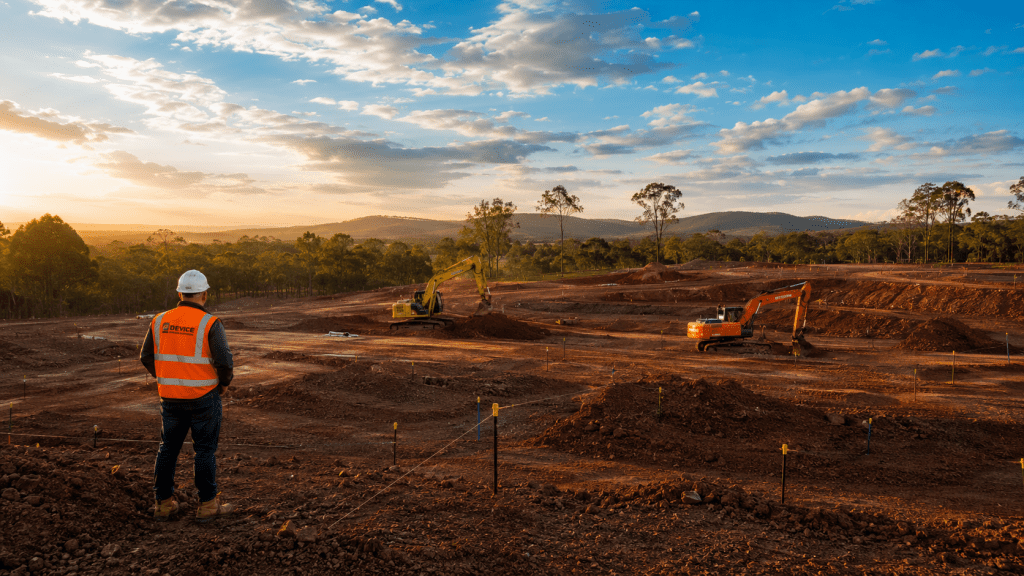
Selecting civil earthworks contractors in South East Queensland requires more than a Google search and three quotes. For developers managing subdivision rollouts, commercial site preparation, or industrial land development across SEQ, your earthworks contractor determines project velocity, compliance outcomes, and ultimately, your margin.
This guide delivers the technical, commercial, and regulatory intelligence you need to evaluate civil earthworks contractors operating across Brisbane’s southern growth corridors, Logan, Ipswich, and the Scenic Rim. We cover scope definitions, council compliance matrices, equipment specifications, pricing variables, and the sequencing logic that separates efficient projects from costly delays.
Whether you’re breaking ground on a 200-lot subdivision in Pallara or preparing a 5,000m² commercial pad in Archerfield, the principles here apply. At Dynamic Earth Solutions, we’ve built our reputation as an indigenous-owned, Supply Nation registered civil contractor delivering earthworks across the Gold Coast and South East Brisbane. This guide reflects what we’ve learned across hundreds of projects.
Civil Earthworks in South East Queensland — What Developers Need to Know
South East Queensland’s development landscape presents unique earthworks challenges that contractors from other regions often underestimate. The combination of reactive clay soils, high water tables in flood-affected corridors, and increasingly stringent council requirements demands contractors with genuine local expertise.
The SEQ Soil Profile Challenge
Across South East Brisbane, soil conditions vary dramatically within single suburbs. Forest Lake sits on heavy clay substrates requiring extensive lime stabilisation for pad construction. Move east to Coopers Plains, and you encounter sandy loams over clay that behave entirely differently under compaction.
Compliance with AS 3798 — Guidelines on earthworks for commercial and residential developments requires contractors to understand these variations and adjust methodology accordingly. A contractor quoting identical per-cubic-metre rates across different SEQ suburbs either hasn’t done their due diligence or intends to claim variations later.
Regulatory Complexity Across Council Boundaries
SEQ developers frequently work across multiple local government areas within a single portfolio. Brisbane City Council’s Natural Assets Local Law (NALL) operates differently from Logan City Council’s vegetation management provisions. Ipswich applies different stormwater management requirements again.
Your civil contractor must navigate these variations without creating compliance gaps that delay practical completion or trigger enforcement action. This regulatory navigation represents a core competency, not an optional extra.
Growth Corridor Dynamics
The South East Brisbane growth corridors — particularly the arc from Heathwood through Pallara to Larapinta — experience concentrated development activity that strains contractor capacity during peak periods. Securing reliable earthworks capacity requires forward planning, not last-minute tendering.
| SEQ Growth Corridor | Primary Development Type | Typical Lot Sizes | Key Earthworks Challenges |
|---|---|---|---|
| Pallara–Heathwood–Larapinta | Masterplanned residential | 300–450m² | Reactive clays, vegetation clearing |
| Acacia Ridge–Rocklea–Archerfield | Industrial/commercial | 2,000–10,000m² | Contamination, existing infrastructure |
| Forest Lake–Richlands | Infill residential | 400–600m² | Access constraints, existing services |
| Sunnybank–Coopers Plains | Mixed use/medium density | 800–2,000m² | Basement excavation, traffic management |
Selecting the Right Civil Earthworks Contractor for Your SEQ Project
Contractor selection extends beyond price comparison. The variables that determine project success include technical capability, fleet availability, council relationships, and financial capacity to sustain operations through project variations.
Contractor Evaluation Framework
Apply this evaluation matrix when shortlisting civil earthworks contractors for SEQ projects:
- QBCC Licensing Verification — Confirm current licensing via the Queensland Building and Construction Commission portal. Check licence classes match your project scope.
- Insurance Currency — Request certificates of currency for public liability ($20M minimum for commercial), professional indemnity, and workers’ compensation.
- Fleet Ownership vs Hire — Contractors owning core equipment deliver more reliable scheduling than those relying heavily on hired plant.
- Council Compliance History — Request evidence of projects completed under BCC, Logan, and Ipswich jurisdictions without enforcement notices.
- Project References — Speak directly with project managers from completed developments, not just supplied testimonials.
- Safety Documentation — Review WHS management systems against WorkSafe Queensland excavation guidelines.
- Financial Capacity — For projects exceeding $500,000, request current financial statements or bonding capacity evidence.
Indigenous Procurement Considerations
Government and corporate procurement increasingly mandates indigenous participation. Supply Nation registered contractors like Dynamic Earth Solutions provide verified indigenous ownership that satisfies these requirements while delivering commercial-grade capability.
To learn more about our team and indigenous ownership credentials, review our registration documentation and project portfolio.
Local Knowledge as Competitive Advantage
A civil contractor Forest Lake operators trust understands that the suburb’s drainage infrastructure connects to Oxley Creek catchments with specific council requirements. This knowledge prevents costly redesigns mid-project.
Similarly, a civil contractor Sunnybank developers rely on knows the suburb’s mix of residential and commercial zoning creates specific access and noise management requirements.
Scope of Civil Earthworks Across Subdivisions, Commercial and Industrial Sites
Civil earthworks scope varies dramatically between project types. Understanding these variations prevents scope gaps that create disputes and delays.
Subdivision Earthworks — Greenfield Development
Greenfield subdivision earthworks in SEQ typically includes:
- Bulk earthworks — mass cut and fill operations establishing road formations and lot levels
- Detailed earthworks — final trimming of lot surfaces to design levels
- Roadworks preparation — subgrade preparation, drainage installation, and base course placement
- Stormwater infrastructure — pipe laying, pit installation, and detention basin construction
- Sewer and water service trenching — often coordinated with utility contractors
- Retaining wall construction — structural and landscaping walls as specified
For subdivision earthworks Brisbane developers commission, volumes commonly range from 50,000m³ to 500,000m³ depending on topography and stage size. Our bulk and detailed excavations capability handles the full spectrum of subdivision requirements.
Commercial Site Preparation
Commercial earthworks Brisbane projects require different methodology. Typical scope includes:
- Demolition of existing structures where applicable
- Contamination remediation under EPA guidelines
- Cut to reduced level for slab preparation
- Compaction to achieve minimum 98% standard maximum dry density
- Service trenching for underground electrical, communications, and hydraulic connections
- Hardstand preparation for parking and loading areas
Industrial sites in suburbs like Rocklea and Archerfield frequently involve contaminated land requiring remediation before civil works proceed. Our demolition services integrate with earthworks delivery for seamless project execution.
Residential Building Site Preparation
Individual lot preparation for residential construction includes:
- Site clearing and grubbing
- Cut or fill to design building platform level
- Compaction testing to AS 1289 requirements
- Footing and pier excavations
- Drainage connections to council infrastructure
Our building site preparation services deliver these requirements with the quality documentation builders require for warranty compliance.
South East Brisbane Civil Hotspots — Where Major Earthworks Happen
Understanding the development characteristics of specific suburbs helps developers and their contractors anticipate challenges and optimise methodology.
Pallara and Heathwood — The Masterplanned Frontier
These suburbs represent SEQ’s most active masterplanned residential development zone. Large-scale bulk earthworks operations transform former agricultural land into subdivision-ready terrain.
Key characteristics for civil contractor Pallara projects include extensive vegetation clearing requirements, significant cut-fill balancing challenges due to undulating topography, and coordination with multiple trunk infrastructure providers.
A civil contractor Heathwood developers engage must navigate similar challenges while managing proximity to established residential areas requiring dust and noise control.
Acacia Ridge and Archerfield — Industrial Transformation
These established industrial suburbs experience ongoing redevelopment as older facilities reach end-of-life. Excavation Acacia Ridge projects frequently involve demolition of existing structures, remediation of contaminated soils, and construction of modern warehouse pads.
Excavation Archerfield works present similar industrial redevelopment challenges, with the added complexity of proximity to Archerfield Airport requiring airspace considerations for any elevated operations.
Rocklea — Flood-Affected Industrial Corridor
Civil works Rocklea projects must address the suburb’s flood history. Council requirements for finished floor levels, stormwater detention, and flood-resilient construction add complexity to standard industrial earthworks.
Geotechnical conditions in flood-affected areas often require enhanced subgrade treatment to achieve compliant bearing capacity.
Richlands and Larapinta — Transitional Development
Excavation Richlands contractors navigate the suburb’s transition from industrial to mixed residential-commercial development. Existing contamination from former industrial uses requires careful management.
A civil contractor Larapinta clients trust understands the suburb’s newer subdivision characteristics and the specific council requirements applying to this growth area.
Coopers Plains and Sunnybank — Infill Intensification
Excavation Coopers Plains projects increasingly involve medium-density infill development. Tight sites, existing infrastructure protection, and traffic management complexity characterise these works.
Sunnybank’s established character and high property values demand premium execution standards from civil contractors.
Equipment, Fleet and Capability Requirements
Civil earthworks capability depends on equipment availability, condition, and operator competency. Developers should verify contractor fleet composition against project requirements.
Core Equipment Categories
| Equipment Category | Typical Sizes | Primary Applications | Approximate Hire Rates |
|---|---|---|---|
| Excavators | 1.7t–50t | Bulk excavation, trenching, demolition | $350–$2,800/day wet |
| Dozers | D4–D9 | Bulk push, spreading, site clearing | $1,200–$3,500/day wet |
| Graders | 12H–14M | Final trimming, road formation | $1,800–$2,400/day wet |
| Compactors | 8t–25t | Fill compaction, subgrade preparation | $800–$1,600/day wet |
| Trucks | 6-wheeler–truck and dog | Material cartage, spoil removal | $130–$180/hour |
| Scrapers | 615–657 | High-volume cut-fill operations | $2,500–$4,500/day wet |
GPS Machine Control
Modern civil earthworks contractors deploy GPS machine control systems that deliver significant productivity and accuracy improvements. These systems provide:
- Real-time cut-fill guidance reducing over-excavation
- Automated blade control for graders achieving ±10mm accuracy
- As-built data capture for compliance documentation
- Reduced survey set-out requirements
Expect contractors with GPS-equipped fleets to deliver 15–25% productivity improvements compared to traditional methods.
Fleet Availability Verification
Request specific equipment allocation for your project during tender evaluation. Contractors may own equipment but have it committed to other projects during your required timeframe. View our complete civil services list and equipment capability overview.
Council Compliance Across Brisbane, Logan, Ipswich, Moreton Bay and Scenic Rim
SEQ’s multi-council structure creates compliance complexity that civil contractors must navigate competently.
Brisbane City Council Requirements
Brisbane City Council planning and development requirements include:
- Development permits for operational works (earthworks exceeding thresholds)
- Natural Assets Local Law compliance for vegetation clearing
- Stormwater management plans per BCC stormwater drainage requirements
- Erosion and sediment control plans with ongoing compliance monitoring
- Traffic management plans for works affecting road networks
BCC maintains strict enforcement of erosion control requirements, with significant penalties for non-compliance during wet weather events.
Logan City Council Specifics
Logan City Council planning requirements apply to the growing suburbs south of Brisbane’s boundary. Logan’s planning scheme includes specific provisions for:
- Koala habitat protection affecting clearing methodology
- Waterway corridor setbacks
- Fill importation quality certification requirements
Ipswich City Council Requirements
Ipswich City Council planning provisions govern works in western SEQ growth areas. Key requirements include:
- Specific contaminated land assessment for former mining areas
- Flood impact assessment for developments in affected zones
- Cultural heritage assessment for significant development sites
Utility Coordination Requirements
All council areas require coordination with utility providers before earthworks commence. Dial Before You Dig Australia enquiries must be lodged and responses obtained before any excavation.
Asset owner requirements typically include:
- Energex — minimum clearances and protection measures for underground and overhead assets
- Urban Utilities — sewer and water main protection, connection permits
- Telstra/NBN — telecommunications infrastructure protection
- APA Group — gas main location and protection
Sequencing Earthworks with Civil, Drainage and Construction Trades
Effective earthworks sequencing maximises productivity while minimising rework and trade conflicts.
Typical Subdivision Earthworks Sequence
- Site establishment (Week 1) — Compound setup, erosion control installation, environmental controls
- Vegetation clearing (Weeks 1–3) — Clearing per approved plans, mulching, timber salvage if applicable
- Topsoil stripping (Weeks 2–4) — Stockpiling for later reinstatement, protection from contamination
- Bulk earthworks (Weeks 3–12) — Major cut and fill operations, haul road establishment
- Drainage installation (Weeks 8–16) — Trunk drainage during bulk earthworks, lot drainage following
- Road subgrade preparation (Weeks 10–18) — Final trimming, proof rolling, lime stabilisation if required
- Service trenching (Weeks 12–20) — Coordinated with utility contractors
- Detailed earthworks (Weeks 16–24) — Lot trimming to final levels
- Road pavement construction (Weeks 18–26) — Coordinated with detailed earthworks completion
- Landscaping and restoration (Weeks 24–30) — Topsoil placement, revegetation, erosion control transition
Critical Path Dependencies
Understanding critical path dependencies prevents costly delays:
- Drainage installation cannot commence until bulk earthworks achieve required invert levels
- Road subgrade preparation requires drainage completion to prevent groundwater impacts
- Service trenching must follow subgrade completion but precede pavement construction
- Lot release requires completion of services to lot boundaries
Our civil drainage installation teams coordinate directly with earthworks operations to optimise these interfaces.
Weather Contingency Planning
SEQ’s subtropical climate delivers significant rainfall during summer months. Effective contractors build weather contingency into programs and deploy resources to capitalise on dry weather windows.
Reactive clay sites may require 2–3 days drying after rainfall before compaction operations can resume. Sandy sites typically recover within hours.
Costing Civil Earthworks in SEQ — Pricing Variables
Earthworks pricing varies significantly based on site conditions, project scale, and market conditions. Understanding pricing variables helps developers evaluate quotations effectively.
Cost Driver Analysis
| Cost Driver | Low Impact | Medium Impact | High Impact |
|---|---|---|---|
| Cut-fill balance | Balanced ±5% | Import/export 10–20% | Major import/export >30% |
| Soil conditions | Free-draining sands | Silty clays | Heavy reactive clays, rock |
| Site access | Multiple access points | Single access, good formation | Restricted access, soft ground |
| Environmental constraints | Cleared site, no habitat | Scattered vegetation | Significant habitat, waterways |
| Working hours | Standard daylight hours | Extended hours available | Restricted hours, noise limits |
| Contamination | Clean fill certification | Low-level remediation | Significant contamination |
Indicative SEQ Pricing Ranges
The following rates provide indicative guidance for budget estimation. Actual pricing depends on specific site conditions and market factors:
- Bulk earthworks (cut and fill on site) — $8–$18/m³
- Bulk earthworks with cartage — $25–$45/m³
- Detailed earthworks (lot trimming) — $12–$22/m³
- Road subgrade preparation — $15–$35/m²
- Lime stabilisation — $8–$15/m² per 150mm layer
- Drainage trenching (600mm depth) — $45–$85/lineal metre
- Stormwater pipe installation — $120–$350/lineal metre depending on diameter
- Rock excavation — $45–$120/m³ depending on methodology
- Compaction testing — $85–$150 per test
Request detailed breakdowns rather than lump sums to facilitate variation management.
Variation Management
Earthworks contracts frequently experience variations due to:
- Geotechnical conditions differing from investigation assumptions
- Design changes during construction
- Weather impacts exceeding reasonable contingency
- Unidentified underground services or structures
- Contamination discovery
Well-drafted contracts include clear variation mechanisms with defined rates for additional work. Contact our team to discuss your project requirements and receive detailed pricing.
Tree Clearing and Vegetation Management Before Earthworks
Vegetation clearing represents a critical pre-earthworks phase requiring specialist expertise and council compliance.
Council Approval Requirements
Brisbane City Council’s Natural Assets Local Law requires approval for clearing significant vegetation. Similar provisions apply across Logan, Ipswich, and other SEQ councils. Approval typically requires:
- Consulting arborist reports documenting existing vegetation
- Arboricultural Impact Assessment evaluating development impacts
- Offset calculations for significant vegetation removal
- Tree protection plans for retained vegetation per AS 4970 — Protection of trees on development sites
Integrated Clearing and Earthworks Delivery
Dynamic Earth Solutions works with our sister company Dynamic Tree Solutions to deliver integrated vegetation management and earthworks. This integration provides:
- Single point of coordination for developers
- Optimised sequencing between clearing and earthworks
- Consistent environmental compliance approach
- Efficient mobilisation and demobilisation
For land clearing Brisbane projects requiring subsequent civil works, this integrated approach delivers significant time and cost savings.
Arborist Engagement Requirements
Council development approvals frequently condition that an AQF Level 5 consulting arborist supervise clearing operations or certify tree protection measures. Early engagement of qualified arborists prevents compliance delays.
Our tree clearing for construction services coordinate directly with arboricultural consultants to ensure compliant delivery.
Vegetation Offset Requirements
Where significant vegetation removal is unavoidable, council approvals typically require:
- On-site replanting at specified ratios (commonly 2:1 or 3:1)
- Off-site offset contributions to council programs
- Financial contributions to environmental offset funds
- Covenant protection of retained vegetation areas
These requirements should be factored into project budgets early in feasibility assessment.
Safety, Insurance and AS Standards Compliance
Civil earthworks operations present significant workplace health and safety risks requiring robust management systems.
Key Safety Hazards
WorkSafe Queensland excavation guidelines identify critical hazards including:
- Excavation collapse — benching, battering, or shoring required for excavations exceeding 1.5m depth
- Underground services strikes — DBYD enquiries and safe excavation practices mandatory
- Mobile plant interactions — pedestrian exclusion zones and spotters for reversing operations
- Overhead powerline contact — approach distances and protection measures per Energex requirements
- Engulfment in trenches — rapid response protocols and rescue equipment availability
Insurance Requirements
Minimum insurance coverage for civil earthworks contractors should include:
- Public liability — $20 million minimum for commercial/subdivision works
- Professional indemnity — $2–5 million for design-related scope
- Workers compensation — full coverage for all employees and deemed workers
- Plant and equipment — replacement value coverage for owned equipment
- Contract works — coverage for works in progress until handover
Review our safety and compliance standards documentation for detailed information on our WHS management approach.
Australian Standards Compliance
Critical Australian Standards for civil earthworks include:
- AS 3798 — Guidelines on earthworks for commercial and residential developments — compaction requirements, testing frequencies, acceptance criteria
- AS 1289 — Methods of testing soils for engineering purposes — laboratory and field test methodologies
- AS 4970 — Protection of trees on development sites — tree protection zones, methodology restrictions
Contractors should provide evidence of methodology compliance with these standards in tender submissions.
Common Mistakes Developers Make with Civil Earthworks
Learning from others’ mistakes prevents costly project impacts. These common errors recur across SEQ development projects.
Mistake 1: Inadequate Geotechnical Investigation
Insufficient geotechnical investigation creates significant project risk. We regularly see developers commission minimum-scope investigations that fail to identify:
- Reactive clay requiring lime stabilisation
- Rock requiring expensive removal methodology
- Contamination requiring remediation
- High water tables requiring dewatering
Invest in comprehensive geotechnical investigation proportionate to project scale and risk.
Mistake 2: Selecting on Price Alone
The lowest tender price rarely delivers the lowest project cost. Budget-priced contractors frequently:
- Submit aggressive claims for variations
- Lack equipment backup causing weather-related delays
- Cut corners on quality requiring rectification
- Exit projects mid-stream when profitability deteriorates
Evaluate total capability, not just tendered price.
Mistake 3: Poor Contract Documentation
Vague scope definitions create disputes. Ensure contracts clearly specify:
- Survey datum and design levels
- Compaction requirements and testing frequencies
- Material specifications for imported fill
- Environmental compliance responsibilities
- Variation procedures and rates
Mistake 4: Ignoring Weather Windows
SEQ’s summer wet season dramatically impacts earthworks productivity. Developers who insist on commencing bulk earthworks in January frequently experience:
- Extended program duration due to rain delays
- Soil moisture problems preventing compaction compliance
- Erosion control failures and environmental enforcement
- Premium labour costs for compressed completion schedules
Plan major earthworks for April–November where possible.
Mistake 5: Underestimating Vegetation Approval Timeframes
Council vegetation clearing approvals frequently take 3–6 months to obtain. Developers who assume this process can be compressed often experience:
- Earthworks mobilisation delays while awaiting approvals
- Contractor demobilisation costs for stop-start programs
- Finance holding costs for delayed project commencement
Commission arborist assessments and lodge applications early in the development approval process.
Frequently Asked Questions
What qualifications should a civil earthworks contractor hold in Queensland?
Queensland civil earthworks contractors must hold appropriate QBCC licensing for the work scope. This typically includes Builder – Open or specific trade contractor licences depending on project value. Verify licence currency directly through the QBCC licence search portal. Additionally, contractors should demonstrate competency against relevant Australian Standards including AS 3798 for earthworks and maintain current WorkCover Queensland workers’ compensation policies for all personnel. Engineers Australia membership for key personnel indicates professional standards commitment.
How long does subdivision earthworks typically take in SEQ?
Subdivision earthworks duration depends on stage size, soil conditions, and weather patterns. A typical 50-lot residential stage in areas like Pallara or Larapinta requires 12–20 weeks from mobilisation to lot release readiness. Larger stages of 100+ lots may extend to 24–36 weeks. Heavy clay sites requiring lime stabilisation add 2–4 weeks compared to free-draining sand sites. Summer wet season works typically experience 20–30% longer duration due to weather delays. Establish realistic timeframes during tender evaluation rather than accepting optimistic contractor programs.
What does civil earthworks cost per square metre in Brisbane?
Civil earthworks costs vary significantly based on scope and conditions. Basic site levelling on flat, clean sites may cost $15–25/m². Full subdivision earthworks including cut-fill, drainage, and road subgrade typically ranges $45–85/m² of developed area. Commercial site preparation with demolition and contamination remediation can exceed $120/m². These rates assume reasonable soil conditions and cut-fill balance. Rock excavation, contamination, and major import/export requirements attract significant premiums. Request itemised quotations to facilitate accurate comparison.
What soil testing is required for civil earthworks in Queensland?
Queensland civil earthworks must comply with AS 1289 for soil testing methodology. Typical requirements include: pre-construction geotechnical investigation establishing design parameters; compaction testing during fill placement at frequencies specified by the geotechnical engineer (commonly 1 test per 500m³ or per 250m² of surface area); California Bearing Ratio (CBR) testing for pavement subgrade; and final lot compaction certification for residential releases. Testing costs typically represent 0.5–1.5% of earthworks contract value. Inadequate testing creates warranty and compliance risks.
How do I select between civil earthworks contractors in South East Queensland?
Effective contractor selection considers multiple factors beyond price. Evaluate QBCC licensing and insurance currency; fleet ownership versus hire arrangements; previous project references in similar scope and location; safety record and WHS management systems; council compliance history; and financial capacity for project scale. Request site visits to current projects to observe operational standards. For projects requiring indigenous procurement, verify Supply Nation registration. Our indigenous-owned story demonstrates our verified credentials.
What permits are needed before commencing earthworks in Brisbane?
Earthworks permits in Brisbane typically include: development permit for operational works where volumes exceed thresholds; Natural Assets Local Law approval for vegetation clearing; erosion and sediment control plan approval; Dial Before You Dig service location enquiries; traffic management plan approval for works affecting roads; and environmental authority for sites with contamination or proximity to waterways. Permit processing timeframes range from 4 weeks for straightforward applications to 6+ months for complex sites. Engage experienced town planners early to manage approval pathways.
What equipment is used for civil earthworks on subdivision sites?
Subdivision earthworks typically requires: excavators (20–35 tonne) for bulk excavation and drainage installation; dozers (D6–D8) for bulk pushing and spreading; scrapers (621–657) for high-volume cut-fill operations on larger sites; graders (14H–14M) for final trimming and road formation; compactors (18–25 tonne) for fill compaction; water carts (15,000–20,000 litre) for dust suppression and moisture conditioning; and trucks (truck and dog configurations) for material cartage. GPS machine control systems on dozers and graders improve accuracy and productivity by 15–25%.
How do weather conditions affect earthworks scheduling in SEQ?
SEQ’s subtropical climate significantly impacts earthworks operations. Summer months (December–March) experience highest rainfall frequency, causing: inability to achieve compaction specifications on saturated soils; erosion control challenges during intense rainfall events; reactive clay swelling requiring extended drying periods; and mobilisation/demobilisation costs for weather interruptions. Most experienced civil contractors program intensive earthworks for April–November when conditions favour productivity. Allow 20–30% program contingency for wet season works. Our emergency civil works Queensland capability addresses weather-related urgent requirements.
What environmental controls are required during earthworks?
Council conditions typically mandate: erosion and sediment control plans prepared by qualified professionals; sediment fencing along all site boundaries and drainage lines; sediment basins sized to contain runoff from design storm events; stabilised entry/exit points preventing material tracking onto roads; progressive rehabilitation of completed areas; dust suppression during dry conditions; and regular monitoring and maintenance. Compliance inspections occur throughout construction with enforcement action for failures. Queensland Reconstruction Authority provides additional guidance for works in flood-affected areas.
What is the difference between bulk earthworks and detailed earthworks?
Bulk earthworks involves large-scale material movement to establish major landform changes. This includes major cut operations, filling to establish design levels, and creation of building platforms and road formations. Tolerances are typically ±50mm to design levels. Detailed earthworks follows bulk operations and involves fine trimming to achieve final design levels with tighter tolerances (±25mm or better). Detailed earthworks also includes creation of lot falls for drainage, final road subgrade preparation, and interface trimming between lots and infrastructure. Different equipment and operator skills apply to each phase.
Can civil earthworks proceed during the wet season?
Wet season earthworks is possible but requires adjusted methodology and expectations. Compaction operations on clay soils typically cannot achieve specification compliance when moisture content exceeds optimum plus 2%. Sandy and gravelly soils tolerate higher moisture content. Work may proceed on: rock excavation unaffected by moisture; drainage installation where trenches can be dewatered; and stockpile operations for later placement. Budget additional time and cost for wet season works, and ensure contracts include appropriate weather delay provisions. Experienced contractors like Dynamic Earth Solutions manage wet season operations effectively through careful planning.
What happens if contamination is discovered during earthworks?
Contamination discovery triggers specific protocols. Works in the affected area must cease pending assessment. The site owner must engage a contaminated land consultant to characterise the contamination. Depending on contamination type and extent, requirements may include: remediation action plan development; regulatory notification to the Department of Environment and Science; remediation works under consultant supervision; and validation sampling confirming remediation success. Contamination-related costs typically fall to the site owner unless contracts specifically allocate this risk. Allow budget contingency for contamination in brownfield development projects.
How do I ensure civil earthworks quality on my development?
Quality assurance for civil earthworks requires: comprehensive specifications in tender documents defining standards and tolerances; geotechnical engineer engagement for design review and construction monitoring; independent compaction testing by NATA-accredited laboratories; surveyor verification of levels against design; hold points in inspection and test plans requiring sign-off before proceeding; and regular site inspections by qualified representatives. Quality documentation should be collated progressively for lot release certification. Our commitment to quality is documented in our safety and compliance standards.
Ready to discuss your civil earthworks requirements in South East Queensland? Dynamic Earth Solutions delivers indigenous-owned civil contracting expertise across the Gold Coast and South East Brisbane growth corridors. Our experienced team handles projects from residential lot preparation to major subdivision earthworks.
Contact our team or call 1300 398 267 to discuss your project requirements and receive a detailed proposal.